

 English
  Español
  Deutsch

Content
- 1 What Metallographic Consumables Are and Why They Determine Result Quality
- 2 Sectioning Consumables: Cut-Off Wheels and Coolant
- 3 Mounting Consumables: Resins, Fillers, and Compression vs. Cold Systems
- 4 Grinding Consumables: Papers, Stones, and Composite Discs
- 5 Polishing Consumables: Cloths, Diamond Suspensions, and Oxide Polishes
- 6 Etching Consumables: Reagents for Microstructure Revelation
- 7 Selecting and Standardizing Metallographic Consumables for Consistent Results
What Metallographic Consumables Are and Why They Determine Result Quality
Metallographic consumables are the expendable materials consumed at each stage of the metallographic preparation workflow — sectioning, mounting, grinding, polishing, and etching — whose combined performance determines whether a microstructural image accurately reflects the true material condition or introduces preparation-induced artifacts. The consumable is the variable that most directly controls surface quality, yet it is also the variable most frequently under-specified relative to the microscope, imaging system, or analytical software it feeds.
For laboratories producing failure analysis reports, incoming material inspection records, or research publications, a preparation sequence built on matched, high-quality consumables is not a cost center — it is the guarantee that conclusions drawn from the microstructure are defensible. An incorrect abrasive grade, a mounting resin with mismatched hardness, or a polishing cloth with the wrong nap height each introduces edge rounding, smearing, pull-out, or relief that distorts the image and invalidates quantitative measurements such as grain size, inclusion rating, or coating thickness.
Sectioning Consumables: Cut-Off Wheels and Coolant
The preparation sequence begins at sectioning, where the choice of cut-off wheel and coolant defines the thermal and mechanical damage zone that all subsequent steps must remove. Two wheel families dominate metallographic sectioning:
- Aluminium oxide (Al₂O₃) wheels for ferrous metals, hardened steels, and cast irons. The friable grain structure continuously self-dresses, maintaining a sharp cutting edge that minimizes heat generation. Wheel hardness (bond grade) must be matched to material hardness — using a hard bond on a hard material glazes the wheel and drives heat into the workpiece.
- Silicon carbide (SiC) wheels for non-ferrous metals, ceramics, and soft materials where Al₂O₃ loading is a risk. SiC is sharper but less tough, making it preferable for materials that smear rather than fracture under cutting stress.
- Diamond cut-off wheels (metal bond or resin bond) for advanced ceramics, cemented carbides, hardened tool steels above 60 HRC, and CFRP composites where conventional abrasive wheels produce excessive chipping or delamination.
Coolant is an equally critical consumable. Water-soluble cutting fluids at 3–5% concentration suppress heat, flush swarf from the cut zone, and prevent corrosion on ferrous samples between sectioning and mounting. Running a precision cut dry — even briefly — can introduce a heat-affected zone extending 50–200 µm below the cut face, requiring proportionally deeper grinding removal to reach undamaged material.
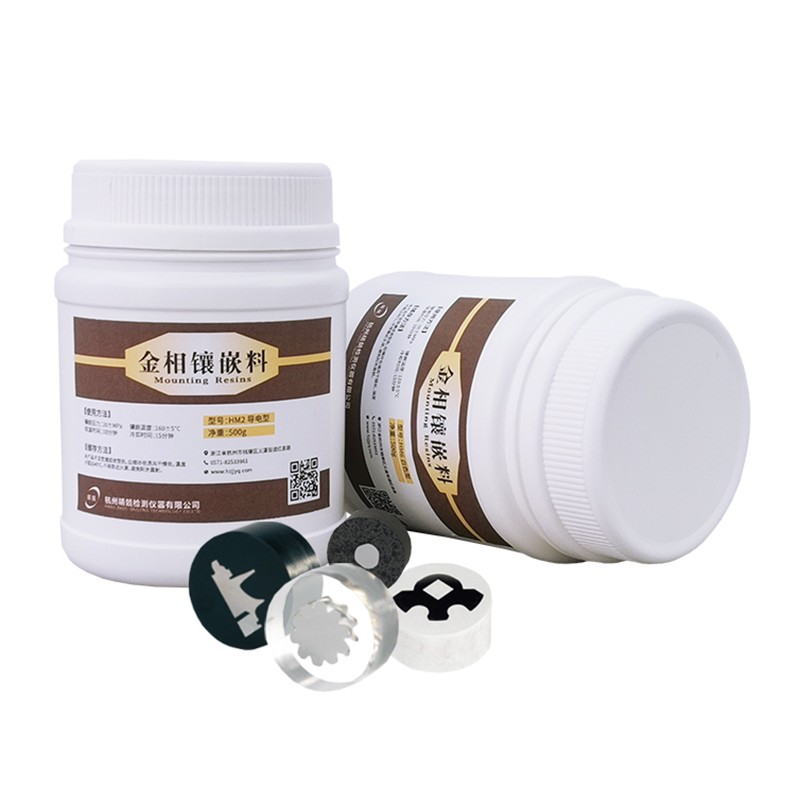
Mounting Consumables: Resins, Fillers, and Compression vs. Cold Systems
Mounting encapsulates the specimen to enable safe handling, protect edges, and fill porosity or cracks that would otherwise trap abrasive and contaminate subsequent preparation stages. The mounting consumable must be matched to both the specimen material and the analytical objective.
Compression (Hot) Mounting Resins
Processed at 150–180°C under 25–35 kN pressure, compression mounting resins produce hard, dimensionally consistent mounts suited to automated preparation. Phenolic resins (Bakelite) are the workhorse choice for bulk ferrous work — low cost, high hardness (HV 30–40), and excellent grindability. Epoxy compression resins offer better edge retention due to higher mount hardness (HV 80–120) and lower shrinkage, making them preferred for coatings analysis, nitrided layers, and case depth measurements where edge rounding of even 5–10 µm would misrepresent the layer profile. Diallyl phthalate (DAP) resins with glass or mineral fillers provide intermediate properties and are used where phenolic's brittleness is a handling concern.
Cold Mounting Systems
Two-component cold mounting systems cure at room temperature without applied pressure, making them essential for heat-sensitive specimens, electronic components, soldered assemblies, and very small or irregularly shaped samples that cannot tolerate hot press conditions. Epoxy cold mount systems (mixed at 2:1 or 5:1 ratio by weight) deliver the best edge retention and chemical resistance of any cold mount option, with cure times of 8–12 hours at ambient temperature, reducible to 1–2 hours at 40–50°C. Acrylic cold mount systems (e.g., methylmethacrylate-based) cure in 5–10 minutes, which suits high-throughput production QC but involves exothermic reactions that can reach 100–120°C locally — a risk for heat-sensitive specimens and solder joints. Polyester systems offer low cost but poor edge retention and significant shrinkage, limiting their use to non-critical screening applications.
For porous materials, sintered metals, thermal spray coatings, and ceramics, vacuum impregnation with low-viscosity epoxy before mounting is a critical step: the epoxy penetrates open porosity under vacuum, preventing pullout of pore walls during grinding and polishing that would otherwise be misinterpreted as material defects.
Grinding Consumables: Papers, Stones, and Composite Discs
Grinding removes the sectioning damage zone and establishes a flat, scratch-controlled surface that polishing can efficiently finish. The choice of abrasive type, grit sequence, and substrate determines how quickly damage is removed and how much new subsurface deformation is introduced.
| Grinding Medium | Abrasive | Best For | Typical Grit Range |
|---|---|---|---|
| SiC paper (waterproof) | Silicon carbide | Ferrous, non-ferrous, general use | P120 – P2500 |
| Diamond grinding disc | Polycrystalline diamond | Hard metals, ceramics, composites | 75 µm – 9 µm |
| Aluminium oxide paper | Aluminium oxide | Soft metals (Cu, Al, brass) | P120 – P1200 |
| Composite grinding stone | SiC or Al₂O₃ in resin bond | High-volume automated labs | 120 – 600 grit equivalent |
The grit sequence step size is as important as the abrasive type. Moving from P320 directly to P1200 — skipping P600 and P800 — leaves residual P320 scratches that a P1200 surface cannot remove without excessive polishing time, leading to relief or rounding at edges and second-phase boundaries. Overlapping grit steps by no more than a factor of 2–2.5 in particle size (e.g., P220 → P500 → P1200 → P2500) produces predictable scratch depth reduction at each stage.
Polishing Consumables: Cloths, Diamond Suspensions, and Oxide Polishes
Final polishing produces the scratch-free, deformation-free surface required for microstructural examination. Three consumable variables interact: the polishing cloth (nap height and material), the abrasive (diamond suspension, slurry, or oxide), and the lubricant or extender fluid.
Polishing Cloths
Woven cloths (nap-free or very low nap, e.g., MD-Dac, DP-Nap equivalents) are used for the fine diamond stages (3 µm, 1 µm) where controlled scratch removal with minimal relief is the priority. They work with polycrystalline diamond suspensions and produce flat surfaces with good edge retention. Synthetic short-nap cloths suit intermediate polishing on most metals. Long-nap cloths (velvet, microfibre) used with colloidal silica or alumina at the final stage deliver the highest surface reflectivity for optical microscopy but introduce relief on multiphase materials if over-used — limiting their application to the final 1–2 minute step.
Diamond Polishing Suspensions and Pastes
Polycrystalline diamond suspensions in water- or oil-based carriers are the primary abrasive for metallographic polishing from 9 µm through 0.25 µm. Polycrystalline diamond particles fracture under load, continuously generating fresh sharp cutting edges — a property that produces lower surface roughness (Ra) at equivalent particle size compared to monocrystalline diamond. Standard sequences run 9 µm → 3 µm → 1 µm for most metals, with 0.25 µm added for EBSD sample preparation or very hard ceramics requiring sub-nanometre surface finish. Diamond suspensions require a matched extender (lubricant) to control aggressiveness; too little extender produces scratching, too much reduces cut rate and risks smearing on soft metals.
Oxide Final Polishing Suspensions
Colloidal silica (SiO₂, 0.04–0.06 µm particle size, pH 9.5–10.5) is the standard final polishing consumable for most materials. Its combination of fine mechanical abrasion and mild chemical activity (particularly on aluminium, titanium, and copper alloys) removes the last nanometre-scale deformation layer that diamond polishing leaves behind, yielding surfaces suitable for EBSD, EBSP, and high-resolution SEM. Colloidal alumina (Al₂O₃, 0.05 µm) is preferred for ferrous materials where silica's chemical activity on iron would introduce surface corrosion during the polishing step.
Etching Consumables: Reagents for Microstructure Revelation
Chemical and electrolytic etching reagents are the final class of metallographic consumables, selectively attacking grain boundaries, phase interfaces, or specific phases to generate the contrast required for optical or electron microscopy. Reagent selection is material-specific and cannot be substituted without altering which microstructural features are revealed.
Widely used reagents include:
- Nital (2–5% HNO₃ in ethanol) — the universal etchant for carbon and low-alloy steels, revealing ferrite grain boundaries, pearlite lamellae, and martensite lath structure. Concentration controls aggressiveness: 2% nital for most steels, up to 5% for highly alloyed or tempered steels.
- Keller's reagent (2 mL HF, 3 mL HCl, 5 mL HNO₃, 190 mL H₂O) — standard etchant for aluminium alloys, revealing grain boundaries and second-phase particles including Si, Fe-bearing intermetallics, and Mg₂Si.
- Marble's reagent (10 g CuSO₄, 50 mL HCl, 50 mL H₂O) — used for stainless steels, nickel alloys, and copper alloys to reveal austenite grain boundaries and segregation.
- Picral (4% picric acid in ethanol) — preferred for revealing carbide structure, prior austenite grain boundaries, and tempered martensite in steels where nital gives insufficient contrast between carbide and matrix.
- Electrolytic etching reagents (e.g., 10% oxalic acid for stainless steel sensitization testing per ASTM A262) apply controlled current density rather than immersion chemistry, offering more reproducible depth control on materials that are difficult to etch uniformly by immersion.
Etching reagents are consumed in small volumes per sample but must be freshly prepared or stored correctly to maintain activity. Nital older than 30 days shows reduced attack rate as HNO₃ is slowly reduced in solution; colloidal silica suspensions that have dried and re-suspended lose particle size distribution uniformity. Consumable freshness is a quality variable, not just a safety concern.
Selecting and Standardizing Metallographic Consumables for Consistent Results
Laboratories that achieve consistently low preparation artifact rates share a common approach: they treat the consumable sequence as a matched system, not a collection of independently sourced items. Mixing abrasive grades from one supplier with cloths and lubricants from another introduces compatibility unknowns that are difficult to diagnose when results are inconsistent. The practical guidance for consumable management is:
- Validate the full sequence on a reference material before deploying it on production or analysis specimens. ASTM E3 and ISO 14250 both describe reference preparation procedures that provide benchmarks for acceptable surface quality at each stage.
- Document consumable lot numbers in preparation records. Batch-to-batch variation in mounting resin shrinkage, diamond suspension particle size distribution, or cloth nap height is real and traceable only if lot data is captured.
- Define consumable replacement intervals based on measured performance rather than time alone. SiC grinding paper degrades after 3–5 mounts on hard steels; diamond discs maintain performance for 100+ mounts on the same material. Using worn abrasives is the most common cause of inconsistent preparation results in production QC labs.
- Source matching lubricants and extenders from the same system as the diamond suspension. Lubricant viscosity and carrier chemistry are optimized by suspension manufacturers for their particle size and binder system; substituting generic lubricants often degrades cut rate and surface finish simultaneously.
- Maintain a single approved supplier list for critical consumables — particularly mounting resins and final polishing suspensions — and control substitutions through a change management procedure. Quality-critical analytical laboratories that switch consumable suppliers mid-project without revalidation risk invalidating the comparability of results across the project timeline.

