What are the common types of Metallographic Grinding and Polishing Machines available on the market?
In metallographic analysis, the metallographic grinding and polishing machine is a vital instrument used for preparing high-quality samples for microscopic observation and material evaluation. Its primary function is to produce a smooth, deformation-free surface that accurately reflects the true microstructure of a material. As industries increasingly emphasize quality control and materials research, the demand for precision in sample preparation has grown substantially.
Hangzhou Jingjing Testing Instrument Co., Ltd. plays a crucial role in advancing this technology. As a comprehensive enterprise specializing in the production, R&D, and service of testing instruments—including hardness testers, tensile testing machines, metallographic microscopes, and metallographic sample preparation systems—the company provides integrated solutions that support both industrial and research institutions. Its team of engineers and technologists has developed and maintained close collaborations with leading domestic manufacturers, enabling continuous innovation in sample preparation technology.
Understanding the purpose of a metallographic grinding and polishing machine
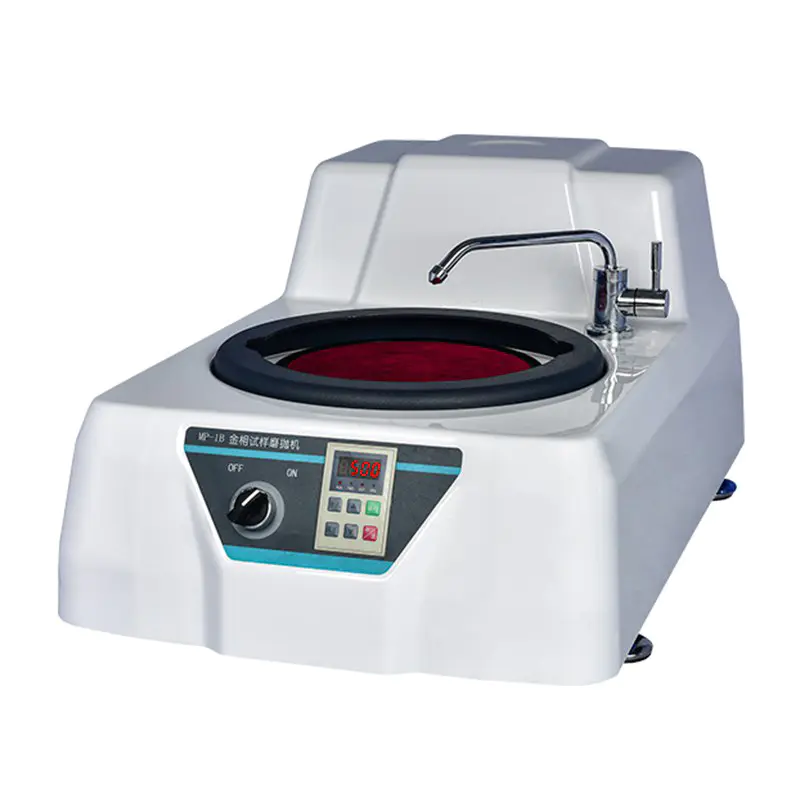
The preparation of metallographic samples requires precision and repeatability. The metallographic grinding and polishing machine is designed to remove surface irregularities, scratches, and deformation layers produced during cutting. This process reveals the true microstructure of metals, alloys, ceramics, and composite materials under optical or electron microscopes.
Grinding typically involves multiple stages using abrasive papers of progressively finer grit, followed by polishing with diamond or alumina suspensions. The ultimate goal is to obtain a mirror-like surface without introducing new defects. The efficiency, stability, and accuracy of these machines directly determine the reliability of metallographic analysis results.
Major classifications of metallographic grinding and polishing machines
Modern machines can be broadly categorized based on automation level, operation mode, number of discs, and functional configuration. The following sections describe these categories in detail.
1. Manual metallographic grinding and polishing machines
Manual models represent the most basic category. Operators manually control sample pressure, movement, and speed during the grinding and polishing process.
Key characteristics:
- Low cost and simple structure.
- Suitable for laboratories with limited budgets or educational institutions.
- Operator experience directly affects consistency and surface quality.
Manual systems are often used in teaching laboratories and basic metallurgical workshops, where the sample quantity is small, and process control is manageable. Although they lack automation, their simplicity allows flexibility for various sample types.
2. Semi-automatic metallographic grinding and polishing machines
Semi-automatic machines combine manual operation with certain automated functions, such as programmable speed control, adjustable pressure, and automatic water supply. The operator places samples on a holder, and the system applies uniform pressure while maintaining consistent speed.
Advantages:
- Improved repeatability compared to manual models.
- Reduced operator fatigue.
- Greater process uniformity for multiple samples.
These machines are widely used in research laboratories and production quality control departments, where medium-volume sample preparation requires both efficiency and flexibility.
3. Fully automatic metallographic grinding and polishing machines
Fully automatic machines represent the most advanced level of metallographic preparation equipment. They integrate automated sample loading, pressure adjustment, multi-step programming, and real-time feedback systems. Users can set precise parameters for each stage—grinding time, polishing duration, speed, and fluid flow rate.
Benefits include:
- Consistent and reproducible sample surfaces.
- Minimal human intervention and higher throughput.
- Digital data storage for quality traceability.
High-end automatic models are often employed in aerospace, automotive, and energy sectors, where process repeatability and traceable precision are essential for certification and failure analysis.
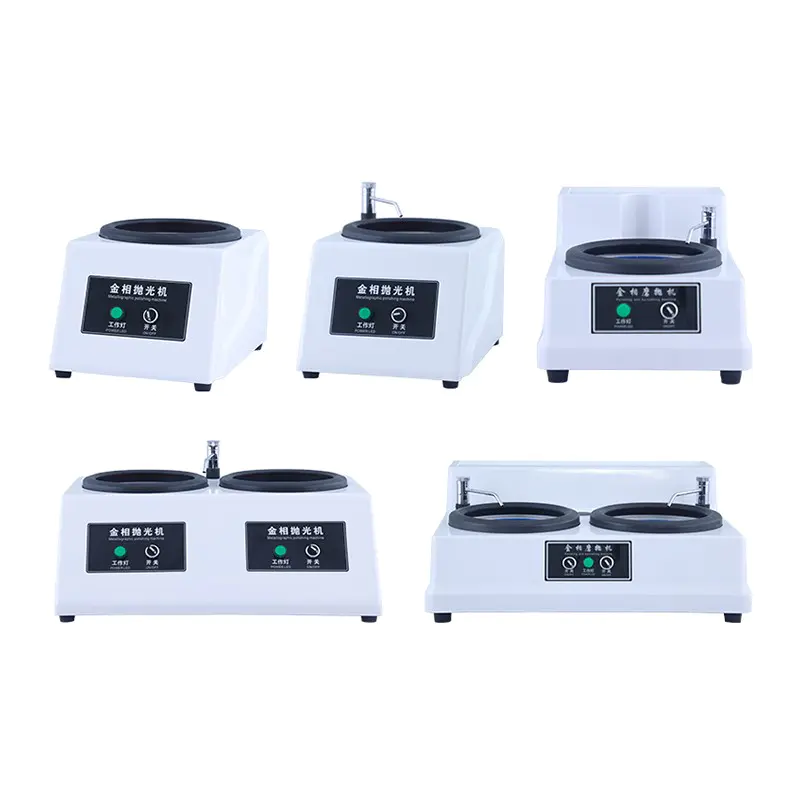
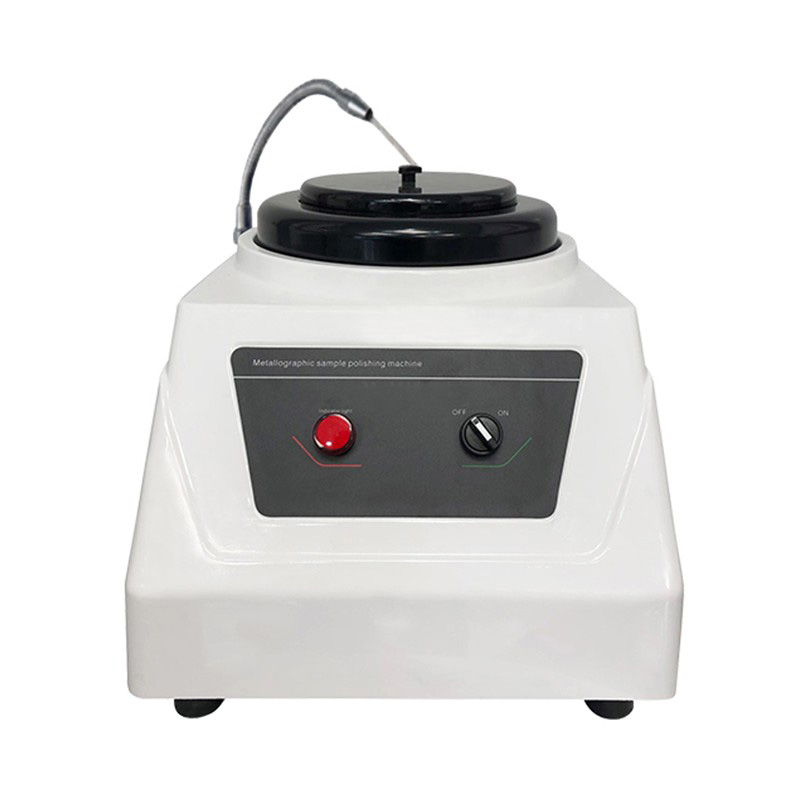
4. Single-disc metallographic grinding and polishing machines
Single-disc models use one working surface for both grinding and polishing, usually requiring manual replacement of abrasive papers or polishing cloths between stages.
Features:
- Compact design and economical choice for limited space.
- Ideal for small-batch preparation tasks.
- Easier maintenance due to simpler structure.
While suitable for basic applications, single-disc systems may not be ideal for high-volume laboratories where preparation speed and throughput are critical.
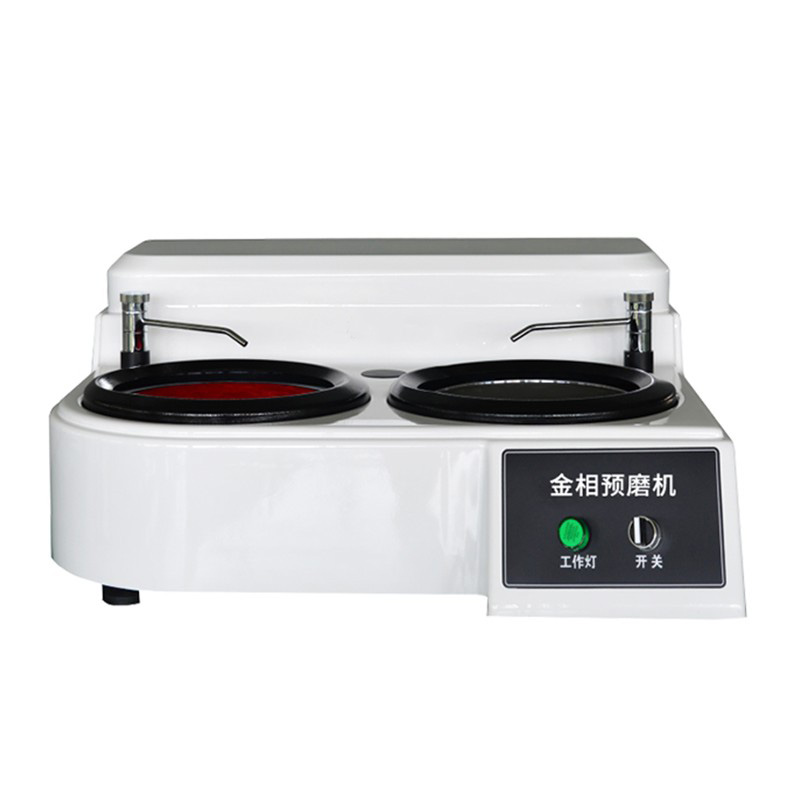
5. Double-disc metallographic grinding and polishing machines
Double-disc machines are equipped with two independent discs, allowing different abrasive stages to be performed sequentially without changing consumables.
Advantages:
- Significant reduction in preparation time.
- Ability to run two processes simultaneously.
- Enhanced flexibility for multiple materials.
These machines are widely used in industrial testing laboratories, where multiple samples of varying hardness must be processed efficiently.
6. Central force and individual force systems
Automatic machines are further divided into central force and individual force configurations, depending on how pressure is applied to samples.
| Configuration Type |
Description |
Typical Application |
| Central Force System |
Applies uniform pressure to all samples simultaneously through a single head. Ensures high consistency for similar materials. |
Routine quality control with homogeneous samples. |
| Individual Force System |
Each specimen holder applies independent pressure, suitable for mixed materials or hardness variations. |
Research laboratories and custom sample preparation. |
Selecting between these two depends on the sample type, material hardness, and precision requirements.
Key technological components of modern metallographic grinding and polishing machines
1. Drive and speed control system
Modern machines feature variable-speed motors that allow continuous adjustment of rotation speed. This capability is crucial for adapting to different materials—from soft aluminum to hard tool steel—without overheating or deformation. Advanced models employ digital feedback mechanisms to maintain constant torque under varying load conditions.
2. Cooling and lubrication system
A recirculating water or coolant delivery system minimizes heat buildup during grinding, preventing microstructural alteration. Automatic fluid dispensers regulate flow rates, ensuring optimal lubrication and cleanliness of the disc surface. The integration of environmentally friendly coolant systems also supports sustainability objectives.
3. Control interface and automation software
State-of-the-art systems are equipped with touchscreen interfaces and programmable logic controllers (PLCs). Users can store multiple process recipes and monitor operation parameters in real time. Data export functions allow traceable records for laboratory management systems, aligning with ISO and ASTM standards.
4. Sample holders and accessories
Sample holders play a crucial role in maintaining stability and uniform pressure during preparation. Modern designs accommodate variable sample diameters and integrate quick-release mechanisms for efficiency. Accessories such as diamond suspension units, polishing cloths, and cleaning systems further enhance workflow reliability.
Industry applications and selection considerations
When selecting a metallographic grinding and polishing machine, users must consider their application environment, sample material, throughput, and required surface quality.
In the automotive industry, for instance, metallographic analysis is used to verify microstructural integrity in heat-treated gears and engine components. Laboratories typically choose fully automatic systems with programmable pressure control to ensure consistent results.
In aerospace applications, where precision and repeatability are critical, machines must support individual force control and fine-grained polishing for nickel-based superalloys and titanium components.
Educational and research institutions, on the other hand, may prefer semi-automatic or manual models due to their versatility and affordability.
The table below summarizes the comparison among main categories:
| Type |
Automation Level |
Efficiency |
Application Field |
Operator Skill Requirement |
| Manual |
Low |
Low |
Education, basic training |
High |
| Semi-automatic |
Medium |
Medium |
R&D, quality control |
Medium |
| Fully automatic |
High |
High |
Aerospace, automotive, industrial labs |
Low |
| Double-disc |
High |
Very High |
Industrial production |
Medium |
Technological innovation and company expertise
Hangzhou Jingjing Testing Instrument Co., Ltd. has been at the forefront of metallographic equipment innovation. Its R&D division includes engineers with over a decade of experience, supported by advanced laboratories and university collaborations. Through continuous improvement, the company has developed AI-assisted image analysis systems achieving a defect detection accuracy of 99.5%.
This innovation directly enhances the precision of metallographic sample preparation, ensuring that grinding and polishing stages meet the requirements of ASTM E407 standards. Furthermore, integration with intelligent control software allows users to automate process optimization, reducing operator intervention and minimizing error rates.
The company’s customized design capability ensures that each metallographic grinding and polishing machine can be adapted to specific industrial needs. From high-volume production environments to specialized research laboratories, every system is built to deliver precision, reliability, and long service life.
Future development trends in metallographic grinding and polishing technology
The industry is rapidly evolving toward intelligent, energy-efficient, and environmentally sustainable solutions. Key trends include:
- Automation and digitalization: Machines are increasingly integrated with data management platforms, enabling remote control and real-time monitoring.
- AI-assisted surface analysis: Artificial intelligence algorithms are being embedded into preparation and evaluation systems to enhance defect recognition accuracy.
- Eco-friendly consumables and water recycling: To reduce environmental impact, manufacturers are developing biodegradable polishing agents and closed-loop coolant systems.
- Modular design: Systems with interchangeable modules allow users to upgrade from manual to semi-automatic or fully automatic configurations without replacing the entire unit.
Hangzhou Jingjing Testing Instrument Co., Ltd. continues to contribute to these advancements through collaborative R&D initiatives, supporting the modernization of metallographic analysis laboratories worldwide.
Conclusion
The metallographic grinding and polishing machine plays a fundamental role in material science, metallurgy, and industrial quality assurance. Whether manual, semi-automatic, or fully automatic, each type serves distinct needs based on precision, efficiency, and user requirements.
As industries demand higher analytical accuracy and process automation, modern systems—supported by innovations such as AI-based control, programmable interfaces, and sustainable coolant technologies—will continue to shape the future of metallographic preparation.
By leveraging its expertise in research, engineering, and customization, Hangzhou Jingjing Testing Instrument Co., Ltd. provides reliable and advanced solutions for global clients seeking excellence in metallographic analysis.


 English
  Español
  Deutsch