

 English
  Español
  Deutsch
Content
- 1 The Role of Polishing Liquids in Precision Surface Finishing
- 2 Alumina Polishing Liquids: Versatile and Widely Applicable
- 3 Diamond Polishing Liquids: Maximum Hardness for Demanding Materials
- 4 Silicon Dioxide Polishing Liquids: Chemical-Mechanical Precision
- 5 Comparing the Three Polishing Liquid Types
- 6 Building a Multi-Step Polishing Sequence
- 7 Quality Indicators When Evaluating Polishing Liquids
The Role of Polishing Liquids in Precision Surface Finishing
Across semiconductor fabrication, metallographic sample preparation, optical component manufacturing, and advanced ceramics processing, the choice of polishing liquid determines whether a surface meets its final specification — or requires costly rework. Unlike solid abrasive films or fixed-abrasive pads, polishing liquids deliver abrasive particles in a precisely engineered suspension, allowing the particle size distribution, concentration, pH, and carrier chemistry to be tuned independently for each application.
Three abrasive chemistries dominate precision polishing workflows: alumina polishing liquids, diamond polishing liquids, and silicon dioxide polishing liquids. Each operates through a distinct combination of mechanical abrasion and chemical interaction with the workpiece surface. Understanding when and how to apply each type — and how to transition between them in a multi-step sequence — is the foundation of a reliable, repeatable polishing process.
Alumina Polishing Liquids: Versatile and Widely Applicable
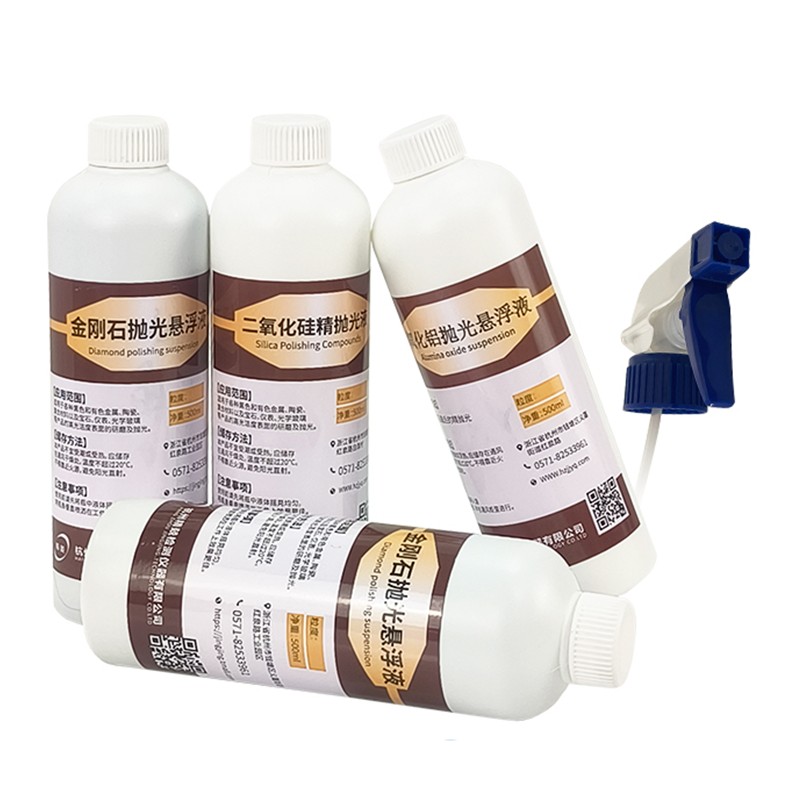
Alumina polishing liquids (also called alumina suspensions or Al₂O₃ slurries) are produced from either calcined alpha-alumina or gamma-alumina particles dispersed in deionized water with stabilizing additives. The two phases differ meaningfully in hardness and morphology: alpha-alumina (Mohs ~9) offers aggressive stock removal, while gamma-alumina (Mohs ~8) provides a finer, more controlled cut that reduces scratch depth on sensitive substrates.
Common particle sizes range from 0.05 µm to 5 µm, enabling alumina liquids to serve both intermediate lapping and final polishing stages depending on the grade selected. Key application areas include:
- Metallographic preparation of ferrous and non-ferrous alloys, hardened steels, and cast irons
- Final polishing of ceramic components and alumina substrates
- Fiber optic connector endface polishing (0.3 µm and 0.05 µm grades)
- Lapping of sapphire windows and watch crystals
- Pre-polish step before colloidal silica final finishing in semiconductor wafer prep
Suspension stability is a critical quality parameter. High-quality alumina polishing liquids maintain a homogeneous particle distribution without hard settling for at least 24 hours at rest, and redisperse fully with gentle agitation. Agglomeration — where fine particles clump into larger clusters — is the primary cause of unexpected deep scratches that invalidate a polished sample. Reputable formulations control zeta potential and use polymeric dispersants to minimize this risk.
Diamond Polishing Liquids: Maximum Hardness for Demanding Materials
With a Mohs hardness of 10 and a fracture toughness that far exceeds any oxide abrasive, diamond is the only abrasive capable of efficiently polishing the full spectrum of hard and superhard materials. Diamond polishing liquids suspend monocrystalline or polycrystalline diamond particles — typically ranging from 0.1 µm to 15 µm — in oil-based, water-based, or alcohol-based carrier fluids.
The carrier chemistry must be matched to both the polishing cloth and the workpiece material:
- Oil-based diamond suspensions provide excellent lubrication and are preferred for composite materials and cermets where water sensitivity is a concern.
- Water-based diamond suspensions clean more easily, are compatible with most polishing cloths, and are the standard choice for ceramics, carbides, and semiconductor device cross-sections.
- Alcohol-based suspensions are used where rapid evaporation is beneficial, such as in thin-section geological sample preparation.
Diamond polishing liquids are indispensable for materials that would quickly glaze or load an alumina or silica abrasive, including:
- Cemented tungsten carbide (WC-Co) cutting tools and dies
- Silicon carbide (SiC) power semiconductor wafers
- Gallium nitride (GaN) and aluminum nitride (AlN) substrates
- Polycrystalline diamond (PCD) tooling
- Zirconia and alumina advanced ceramics
- Geological thin sections and mineral samples
Particle size selection follows a straightforward logic: coarser grades (6–15 µm) remove grinding damage rapidly in the early polishing stage, while finer grades (0.25–1 µm) refine the surface toward a mirror finish. Many laboratories run three successive diamond steps (e.g., 9 µm → 3 µm → 1 µm) before transitioning to a final oxide polish.
Silicon Dioxide Polishing Liquids: Chemical-Mechanical Precision
Silicon dioxide polishing liquids — commonly called colloidal silica suspensions — operate on a fundamentally different principle than alumina or diamond abrasives. The SiO₂ particles (typically 20–100 nm in diameter) are far too small to remove material through mechanical abrasion alone. Instead, they work in concert with the alkaline carrier (pH 9–11) to chemically soften or activate the outermost atomic layer of the workpiece surface, which the nano-silica particles then gently shear away. This chemo-mechanical mechanism produces scratch-free surfaces with sub-nanometer roughness — results that mechanical abrasion alone cannot achieve.
Silicon dioxide polishing liquids are the final-step standard for several critical applications:
- Silicon wafer CMP (chemical mechanical planarization): Colloidal silica slurries planarize silicon device wafers to surface roughness values below 0.1 nm Ra, enabling sub-10 nm lithography nodes.
- EBSD and electron backscatter diffraction sample preparation: A colloidal silica vibratory polish removes the mechanically deformed surface layer left by prior diamond steps, revealing the true crystallographic structure of metals and alloys.
- Optical glass and fused silica finishing: Eliminates subsurface damage and achieves surface roughness compatible with high-power laser applications.
- Sapphire substrate final polish: Produces epi-ready surfaces for LED and RF device epitaxy.
- Metallographic final polish for soft metals: Aluminum, copper, and titanium alloys respond particularly well to colloidal silica, which avoids the pitting and smearing associated with alumina on these materials.
The pH sensitivity of colloidal silica suspensions deserves careful attention. Dilution with tap water or contamination with acidic residues from previous polishing steps can destabilize the suspension, causing irreversible gelation. Always use deionized water for dilution and thoroughly clean polishing cloths between abrasive types.
Comparing the Three Polishing Liquid Types
| Property | Alumina Polishing Liquid | Diamond Polishing Liquid | Silicon Dioxide Polishing Liquid |
|---|---|---|---|
| Abrasive hardness (Mohs) | 8–9 | 10 | ~7 (nano) |
| Typical particle size | 0.05–5 µm | 0.1–15 µm | 20–100 nm |
| Removal mechanism | Mechanical | Mechanical | Chemo-mechanical |
| Material range | Metals, ceramics, fiber optics | Superhard materials, carbides, wide-bandgap semiconductors | Silicon, soft metals, glass, sapphire |
| Typical polishing stage | Intermediate to final | Coarse to fine intermediate | Final only |
| Achievable roughness | 1–10 nm Ra | 0.5–5 nm Ra | <0.1 nm Ra |
Building a Multi-Step Polishing Sequence
Rarely does a single polishing liquid carry a surface from a ground or lapped condition all the way to a final finish. Professional workflows combine all three abrasive types in a logical sequence, with each step removing only the damage introduced by the previous one:
- Coarse diamond (9–15 µm): Rapid removal of grinding marks and sectioning damage. Used on a rigid or semi-rigid polishing disc.
- Fine diamond (1–3 µm): Refines the surface and reduces scratch depth to below 1 µm. Cloth selection matters — a harder cloth maintains flatness, a softer cloth conforms to topography.
- Alumina (0.3–0.05 µm): Bridges the transition between diamond and colloidal silica for materials where direct transition introduces artifacts. Often used for steels and copper alloys.
- Colloidal silica (20–40 nm): Final chemo-mechanical step that removes residual deformation and delivers the lowest achievable surface roughness. Extended vibratory polishing (1–8 hours) is common for EBSD-quality metallographic samples.
Cross-contamination between steps is the most common source of process failure. Even a few diamond particles carried onto a colloidal silica cloth will introduce deep scratches that the silica step cannot remove. Dedicated cloths, thorough sample cleaning between steps, and separate dispensing equipment for each liquid are non-negotiable practices in any quality-controlled polishing laboratory.
Quality Indicators When Evaluating Polishing Liquids
Not all polishing liquids of the same nominal specification perform equally. When qualifying a new supplier or product, experienced laboratory managers evaluate the following:
- Particle size distribution (PSD) documentation: A reputable supplier provides D10, D50, and D90 values measured by laser diffraction or dynamic light scattering, not just a nominal average.
- Absence of oversize particles: For diamond liquids, the presence of even a small fraction of particles significantly larger than the stated size causes catastrophic scratching. Request data on the maximum particle size (D99 or D100).
- Shelf life and storage conditions: High-quality colloidal silica and alumina suspensions typically carry a 12–24 month shelf life when stored between 5 °C and 30 °C. Freeze-thaw cycles irreversibly destabilize many formulations.
- Lot-to-lot consistency: Certificate of analysis (CoA) data across multiple production lots should show tight control of pH, solids content, and PSD.
- Compatibility testing: Always validate a new polishing liquid on a reference sample of known surface finish before committing it to production or critical research samples.
Selecting the right combination of alumina, diamond, and silicon dioxide polishing liquids — and using each under the conditions it was formulated for — is the single most impactful variable a laboratory can control in pursuit of consistent, defect-free surface finish results.

