

 English
  Español
  Deutsch

Content
- 1 Metallographic Sample Preparation: Why It Matters Before Any Hardness Test
- 2 What Is the Vickers Hardness Test Used For?
- 3 Rockwell Hardness Reference Blocks: Calibration, Traceability, and Proper Use
- 4 What Is HK in Hardness? Knoop vs. Vickers for Micro-Hardness Work
- 5 Converting Brinell Hardness to Ultimate Tensile Strength
- 6 Tensile Strength from Rockwell Hardness: Conversion Methods and Limits
Metallographic Sample Preparation: Why It Matters Before Any Hardness Test
Accurate hardness testing begins long before the indenter contacts the specimen. Metallographic sample preparation — the controlled process of sectioning, mounting, grinding, and polishing a metal sample — directly determines whether a hardness reading reflects the material's true properties or an artifact introduced during handling.
For micro-hardness methods in particular, surface condition is critical. A poorly polished specimen introduces topographic variation that deflects the indenter, inflates scatter, and produces readings that cannot be correlated with any published conversion table. The general requirement for Vickers and Knoop micro-hardness testing is a surface finish of 0.1 µm Ra or better — achievable only through systematic metallographic preparation.
The preparation sequence typically includes:
- Sectioning with an abrasive cut-off wheel using adequate coolant to prevent thermal damage
- Cold or hot mounting in epoxy or phenolic resin to provide edge support and safe handling
- Planar grinding to remove sectioning damage and achieve a flat reference plane
- Sequential grinding through progressively finer SiC abrasives (typically 240 → 400 → 600 → 1200 grit)
- Diamond polishing (6 µm, then 3 µm, then 1 µm) to eliminate all grinding scratches
- Final polishing with colloidal silica (0.04–0.05 µm OPS) for mirror-finish surfaces required by micro-hardness standards
Each stage must fully remove damage from the previous one. Skipping steps or rushing dwell time embeds deformed subsurface layers — work-hardened zones that produce false-high Vickers readings in the range of 10–50 HV, a significant error when testing thin coatings, heat-affected zones, or case-hardened layers.
What Is the Vickers Hardness Test Used For?
The Vickers hardness test is used to measure the resistance of a material to permanent indentation using a square-based diamond pyramid indenter with a 136° face angle. It is the most versatile macro- and micro-hardness method available, applicable to virtually any solid material regardless of hardness level, and is the preferred method when precision, traceability, or microstructural resolution are required.
In practice, the Vickers test is used for:
- Case depth measurement — profiling hardness gradients across carburized, nitrided, or induction-hardened surfaces by making a series of indentations at increasing distances from the surface
- Thin coating evaluation — assessing PVD/CVD hard coatings, electroplated layers, and diffusion treatments where the affected zone may be only a few microns thick
- Weld quality inspection — mapping hardness across the base metal, heat-affected zone, and weld bead to detect softening, over-hardening, or hydrogen cracking susceptibility
- Failure analysis — identifying decarburization, untempered martensite, retained austenite, or phase boundaries through localized hardness measurements
- Material certification — verifying heat treatment outcomes in aerospace, automotive, and tooling components per specifications such as AMS, ISO 6507, and ASTM E92
- Research and development — characterizing newly developed alloys, sintered ceramics, and composite materials where no pre-existing conversion scales exist
Because the Vickers scale is continuous from roughly 5 HV (very soft lead alloys) to over 3000 HV (diamond), no range changes are needed. A single method covers soft copper (40–80 HV), hardened tool steel (700–900 HV), and cemented carbide (1400–1800 HV). This continuity makes Vickers the foundation of all international hardness conversion tables.
Rockwell Hardness Reference Blocks: Calibration, Traceability, and Proper Use
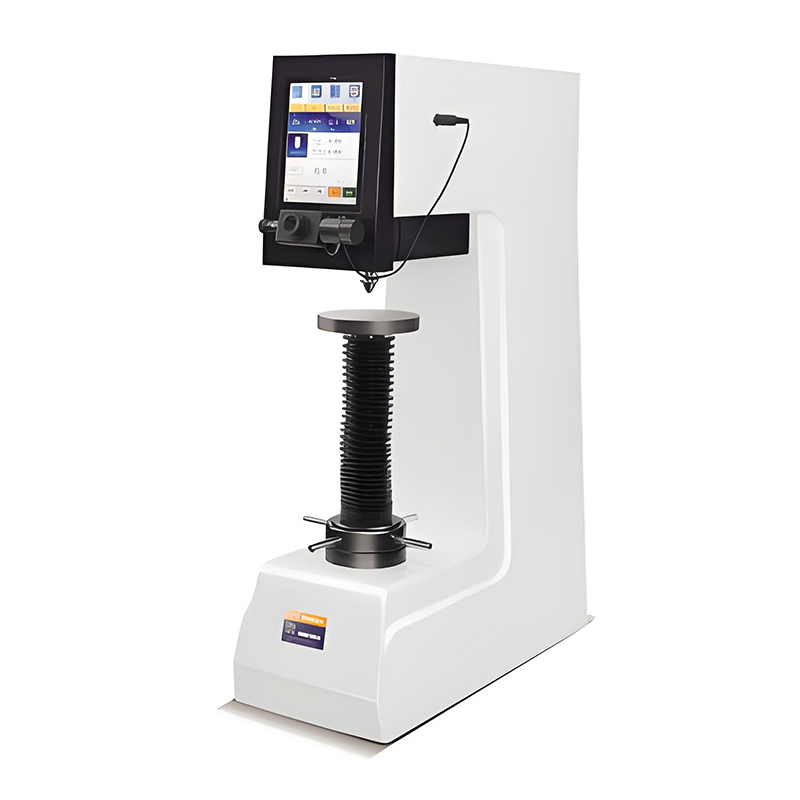
A Rockwell hardness reference block (also called a test block or calibration block) is a precision-ground, certified metal coupon used to verify that a Rockwell hardness tester is performing within stated accuracy limits. It is not a consumable — a single certified block typically supports hundreds of verification measurements when used correctly.
Per ASTM E18 and ISO 6508, reference blocks must be calibrated on a primary standardizing machine traceable to a national metrology institute (NIST in the United States, PTB in Germany, etc.). Each block is shipped with a certificate stating the certified hardness value, measurement uncertainty, and the number of valid test locations remaining on the block surface.
Correct Use of Reference Blocks
Common errors that invalidate reference block measurements include testing on the chamfered edges, re-using indentation sites within a 3-indent-diameter exclusion zone, and testing on the bottom face (which has a different residual stress state than the calibrated top face). Only the clearly marked top surface is valid for verification testing.
Daily verification should be performed with blocks close in hardness to the material being tested. Using a 60 HRC block to verify a machine that will test 25 HRC parts is technically permissible but practically less sensitive to the systematic errors — anvil seating, indenter condition, and load cell drift — that affect mid-range readings.
Blocks should be stored in a closed case, away from humidity and vibration, and handled with cotton gloves to prevent corrosion of the polished surface. A block that has been dropped, scratched through its active zone, or shows surface oxidation should be retired from calibration use.
What Is HK in Hardness? Knoop vs. Vickers for Micro-Hardness Work
HK stands for Hardness Knoop, the scale used in the Knoop micro-hardness test. Like Vickers (HV), Knoop uses a diamond pyramid indenter and optical measurement of the resulting impression — but the geometry differs fundamentally. The Knoop indenter produces an elongated rhombohedral indentation with a 7.11:1 diagonal ratio, whereas Vickers produces a nearly square indent.
This geometric difference has two important practical consequences:
- Shallower penetration depth — the Knoop indent is approximately 1/30th of the long diagonal in depth, compared to 1/7th for a Vickers indent of the same diagonal length. This makes Knoop significantly better for very thin coatings, brittle ceramics, and glass where deep penetration would cause cracking or substrate influence.
- Directionality sensitivity — the elongated shape can reveal crystallographic anisotropy in single crystals or highly textured materials by rotating the sample relative to the indenter axis.
Knoop is the preferred method under ASTM E384 for testing: cemented carbides, hardened glass, thin galvanic layers, and materials where cracking around the Vickers indent would compromise measurement validity. For most steel, aluminum, and copper alloy applications, Vickers micro-hardness (HV 0.1 to HV 1) is the default choice due to its simpler geometry and direct convertibility to other hardness scales.
| Parameter | Vickers (HV) | Knoop (HK) |
|---|---|---|
| Indenter shape | Square pyramid (136°) | Elongated pyramid (7.11:1 ratio) |
| Indent depth relative to diagonal | ~1/7 | ~1/30 |
| Best for | Metals, alloys, heat-treat profiles | Ceramics, glass, thin coatings |
| Standard | ASTM E92 / ISO 6507 | ASTM E384 |
| Scale conversion | Direct tables to HRC, HB, UTS | No universal conversion to Rockwell |
Converting Brinell Hardness to Ultimate Tensile Strength
Brinell hardness (HBW) correlates linearly with ultimate tensile strength (UTS) for a broad range of steels and cast irons, making it one of the most practically useful hardness-to-strength conversions in engineering. The relationship arises because both properties are governed by the resistance of the material's microstructure to plastic flow under a concentrated load.
The widely applied approximation for carbon and low-alloy steels is:
UTS (MPa) ≈ 3.45 × HBW
In US customary units: UTS (psi) ≈ 500 × HBW
These coefficients hold reasonably well for ferritic, pearlitic, and martensitic steels in the range of 150–400 HBW. Accuracy typically falls within ±7% for normalized or quenched-and-tempered carbon steel, which is sufficient for material verification and incoming inspection purposes.
The relationship degrades and should not be used without material-specific data in the following cases:
- Austenitic stainless steels — work hardening behavior differs significantly from ferritic steels; the multiplier is closer to 3.3–3.55 and varies by alloy
- Aluminum alloys — a multiplier near 3.6–3.8 is often cited, but scatter is high across different temper conditions
- Cast iron — graphite morphology (flake vs. nodular) introduces a secondary microstructural variable; published tables for ductile iron and grey iron should be consulted separately
- HBW > 400 — the linear relationship breaks down; Vickers or Rockwell C conversion via ASTM E140 is more reliable at high hardness levels
ASTM A370 and EN ISO 18265 both provide tabulated hardness-to-tensile-strength conversion data with stated applicability ranges and expected uncertainties, and should be the reference documents for any specification-critical conversion.
Tensile Strength from Rockwell Hardness: Conversion Methods and Limits
Estimating tensile strength from Rockwell hardness follows a two-step process: first convert Rockwell to Brinell using ASTM E140 conversion tables, then apply the Brinell-to-UTS relationship described above — or use direct UTS correlation tables that consolidate both steps.
For hardened steel in the HRC 20–65 range, the following approximate equivalencies provide a practical starting point:
| Rockwell C (HRC) | Brinell (HBW) | Approx. UTS (MPa) | Approx. UTS (psi) |
|---|---|---|---|
| 20 | 226 | 780 | 113,000 |
| 30 | 286 | 987 | 143,000 |
| 40 | 371 | 1,280 | 185,500 |
| 50 | 481 | — | — (linear formula invalid above ~400 HBW) |
| 60 | 746 | — | — (use direct tensile testing) |
Above HRC 40 (~400 HBW), the Brinell test itself is no longer valid because the 10 mm carbide ball deforms elastically at high loads, producing non-reproducible results. In this range, Vickers or Rockwell C are the correct hardness methods, and UTS estimation should reference direct empirical tables for the specific steel grade rather than the generic linear formula.
For engineering decisions involving safety-critical components — pressure vessels, structural fasteners, crankshafts — hardness-derived UTS values should be treated as screening data only. Physical tensile testing per ASTM E8 or ISO 6892 is required for design basis certification.

