

 English
  Español
  Deutsch

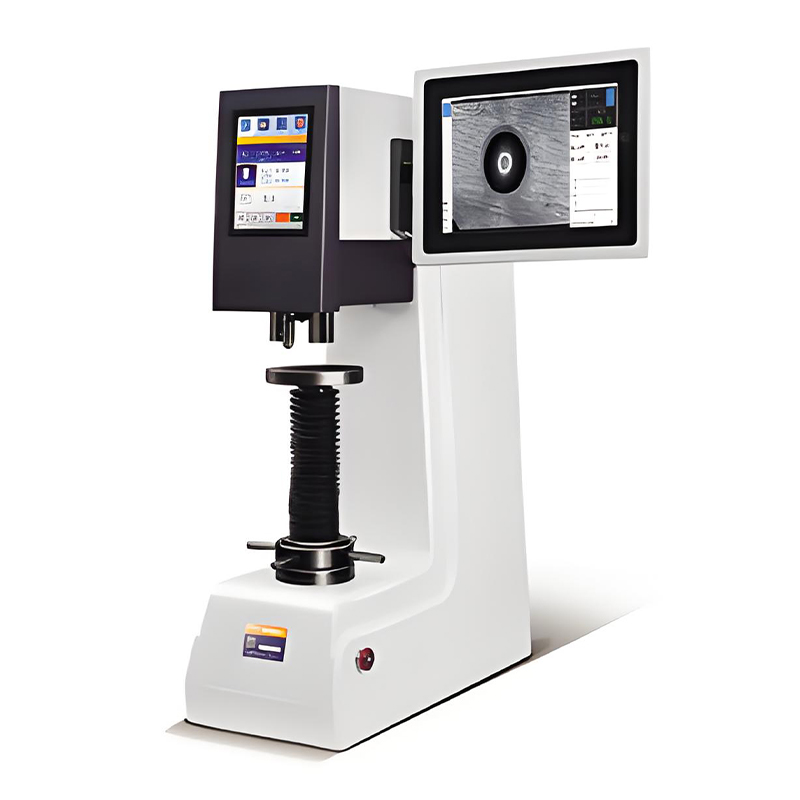
Hardness is a measure of a material's resistance to permanent indentation. In metal hardness testing, the answer to how hardness is measured is simple: a standardized indenter is pressed into the surface under a precise load, and the size or depth of the impression is converted into a hardness number. For steel hardness testing on the production floor, the Rockwell method is the overwhelming choice, with 60 HRC representing a typical hardened tool steel and 25 HRC representing a soft, machinable mild steel. A United Rockwell hardness tester is a specific digital instrument that automates this test, delivering results in seconds. For softer, non-metallic materials, Shore hardness testers measure the penetration of a spring-loaded indentor and are essential for elastomers and polymers. This article provides a practical, method-by-method exploration of hardness checking methods, from the classic Brinell and Vickers techniques to portable rebound testers, with concrete steel hardness examples.
Content
- 1 How Hardness Is Measured: The Fundamental Principles
- 2 Rockwell Hardness Testing: The Industry Standard for Metal
- 3 Steel Hardness Testing and Typical Rockwell Hardness Examples
- 4 The United Rockwell Hardness Tester: A Practical Bench Solution
- 5 Brinell Hardness Testing for Bulk and Coarse Materials
- 6 Vickers Hardness Testing: Precision Across All Scales
- 7 Shore Hardness Testers for Elastomers and Polymers
- 8 How to Perform a Hardness Test: A Step-by-Step Guide
- 9 Selecting the Right Hardness Checking Method
How Hardness Is Measured: The Fundamental Principles
All static hardness measuring methods share a common sequence: an indenter of a known geometry is pressed into the material at a controlled force and rate, the force is held for a defined dwell time, and then the indentation is measured. The hardness number is derived from either the depth of penetration or the surface area of the impression. The three most common indenter types are a diamond cone, a hardened steel or carbide ball, and a diamond pyramid. The essential difference between methods lies in the combination of indenter, applied force, and measurement approach.
In metallurgy hardness testing, the process yields more than just a number. It reflects the material's yield strength, work-hardening rate, and microstructure. A Brinell test on a coarse-grained casting, for example, averages the hardness of multiple grains, while a Vickers micro-indentation at 0.5 kgf can isolate the hardness of a single grain boundary carbide. Understanding the measurement principle is the first step to selecting the correct test.
Rockwell Hardness Testing: The Industry Standard for Metal
Rockwell hardness testing is the dominant metal hardness testing method for production environments because it is fast, non-destructive on a macro scale, and does not require optical measurement. The test works by first applying a minor load (typically 10 kgf) to seat the indenter and establish a zero reference. A major load (60, 100, or 150 kgf) is then applied and subsequently removed, leaving only the minor load. Hardness is read directly from a dial or digital display as an inverse function of the permanent depth increase. A typical test cycle takes less than five seconds.
The most common scales are HRC and HRB. HRC uses a diamond cone indenter and a 150 kgf major load and is used for hardened steels and titanium alloys. HRB uses a 1/16-inch carbide ball and a 100 kgf major load for softer materials like copper alloys and unhardened steel. A Rockwell hardness example that guides much of industry is the specification of case-hardened gears at 58–62 HRC, which provides optimal wear resistance without excessive brittleness.
Steel Hardness Testing and Typical Rockwell Hardness Examples
Steel hardness testing is the most frequent application of bench hardness testers, and Rockwell values serve as the universal language for specifying heat treatment. The table below gives direct, practical examples of hardness for common steel conditions. These values are what a quality engineer expects when placing a sample on a United Rockwell hardness tester.
| Steel Type and Condition | Rockwell Hardness | Equivalent Vickers | Typical Use |
|---|---|---|---|
| Mild steel (AISI 1018), annealed | 25 HRC | 260 HV | Structural components, shafts |
| Medium-carbon steel (AISI 1045), quenched and tempered | 40 HRC | 390 HV | Machine parts, crankshafts |
| Alloy steel (AISI 4140), hardened | 52 HRC | 545 HV | Gears, axles, high-stress fasteners |
| Tool steel (D2), hardened and tempered | 60 HRC | 700 HV | Cutting tools, dies, punches |
| Bearing steel (AISI 52100), through-hardened | 64 HRC | 825 HV | Rolling element bearings |
The United Rockwell Hardness Tester: A Practical Bench Solution
The United Rockwell hardness tester is a specific brand of digital bench hardness tester widely used in metallurgy hardness testing and quality assurance. Models in the United TRU Series execute all regular and superficial Rockwell scales, including HRC, HRB, and HRN/T, with a closed-loop force application system that ensures accuracy better than plus or minus 0.5 HRC. The instrument automates the minor load seating, major load application, dwell, and unloading sequence at the press of a button, eliminating operator influence on the result. For steel hardness testing, this means a technician can test a batch of 50 shaft samples and obtain consistent, repeatable numbers without optical measurement. The tester’s digital display shows the hardness value directly, and data can be exported for statistical process control, making it a central tool in any hardness checking method library for metals.
Brinell Hardness Testing for Bulk and Coarse Materials
Brinell is the preferred hardness measuring method for materials with a coarse or heterogeneous microstructure, such as iron castings, forged parts, and copper alloys. A 10 mm tungsten carbide ball is pressed into the surface under a high load, commonly 3000 kgf for steel and 500 kgf for soft non-ferrous metals. After load removal, the diameter of the impression is measured with a calibrated microscope. The hardness number, reported as HBW 10/3000 for example, is the applied load divided by the surface area of the indentation. Because the large ball samples many grains, the result is a reliable bulk hardness that correlates well with tensile strength for many metals. A typical example of hardness from this method is 200 HBW for a gray cast iron.
Vickers Hardness Testing: Precision Across All Scales
Vickers is unique among hardness measuring methods because the same diamond square-based pyramid indenter is used for forces from 1 gf to 120 kgf, making the test applicable to everything from a 3-micron coating to a thick steel plate. The indentation diagonals are measured optically, and the hardness, expressed as HV, is load-independent over a wide range. In metallurgy hardness testing, Vickers is essential for case depth determination, where a series of indentations at 0.5 or 1 kgf is made from the surface to the core to map the hardness gradient. It is also the reference method for qualifying weld zones and thin foils where Rockwell and Brinell would miss critical variations. An example of hardness for a nitrided surface is 1000 HV 0.5, declining to 300 HV in the core.
Shore Hardness Testers for Elastomers and Polymers
Shore hardness testers are portable instruments that measure the resistance of rubbers, plastics, and other non-metallic materials to indentation by a spring-loaded indentor. The two most common scales are Shore A for soft rubber and Shore D for hard plastics. A durometer reading of 60 Shore A is typical for a rubber tire tread, while 80 Shore D indicates a hard hat material. The measurement is quick and non-destructive, making it a standard hardness checking method on the production floor and in the field. While not used for metals, Shore testers are a critical component of a complete hardness testing capability for hybrid components like bonded rubber-to-metal mounts.
How to Perform a Hardness Test: A Step-by-Step Guide
The following practical procedure illustrates how to hardness test using a Rockwell bench tester, the most common industrial scenario. The same principles of sample preparation, machine verification, and indentation spacing apply across all methods.
- Verify the tester. Run a daily calibration check on a certified test block of known hardness. The reading must be within the stated tolerance, typically plus or minus 1.0 HRC for the HRC scale.
- Prepare the sample surface. The test surface and the anvil seat must be clean, dry, and free of scale or decarburization. For thin or irregular parts, use the correct elevating screw and anvil insert to ensure stability.
- Select the correct scale and indenter. For hardened steel above 20 HRC, install the diamond cone indenter and select the HRC scale. For brass or unhardened steel, use the 1/16-inch ball and HRB scale.
- Apply the minor load. Slowly raise the elevating screw until the indenter contacts the sample and the minor load is fully applied, indicated by a reference mark or beep.
- Apply the major load and dwell. Actuate the test cycle. The machine applies the full major load, holds it for the specified dwell time (typically 3–6 seconds), and automatically releases back to the minor load.
- Read the hardness value. The Rockwell number is displayed directly. Record the value and the scale, e.g., 58.5 HRC.
- Maintain proper spacing. The distance between indentations must be at least three times the diameter of the indentation, and each indentation must be at least 2.5 times the diameter from the edge of the sample to avoid work-hardening interference.
Selecting the Right Hardness Checking Method
The choice of hardness measuring method is driven by material type, part geometry, the scale of the microstructure, and whether the test is for production release or failure analysis. The table below summarizes the primary hardness checking methods for metal and non-metal applications, providing a practical selection guide.
| Method | Best for | Indenter | Key Standard |
|---|---|---|---|
| Rockwell (HRC, HRB) | Production metal testing, steels | Diamond cone or carbide ball | ISO 6508, ASTM E18 |
| Brinell (HBW) | Castings, forgings, bulk metal | 10 mm carbide ball | ISO 6506, ASTM E10 |
| Vickers (HV) | Thin layers, coatings, welds, R&D | Diamond pyramid (136 deg) | ISO 6507, ASTM E92 |
| Shore (A, D) | Elastomers, plastics, soft polymers | Spring-loaded indentor | ISO 868, ASTM D2240 |
| Leeb (Rebound) | Large, installed components | Tungsten carbide ball impact | ISO 16859, ASTM A956 |
A final practical point: no single hardness test is universal. A well-equipped metallurgy laboratory uses a United Rockwell hardness tester for daily steel production checks, a Vickers microhardness tester for failure analysis, and a portable Shore meter for incoming rubber inspections. Matching the method to the material and the required information is the foundation of reliable hardness testing.

