

 English
  Español
  Deutsch

Hardness is not a fundamental material property but a measured response to a specific indentation method. The direct practical answer is that Rockwell, Brinell, and Vickers are three distinct indentation hardness tests, each using a different indenter and load, and producing values in different units or scales. Rockwell uses a depth measurement and reports a dimensionless number on scales like HRC or HRB. Brinell presses a carbide ball into the surface and reports a value in HBW (kgf/mm²). Vickers uses a diamond pyramid and reports hardness as HV (also in kgf/mm²), making it versatile for everything from thin coatings to bulk materials. A universal hardness testing machine integrates these methods into a single instrument, often adding a depth-sensing Martens hardness capability. There is no single hardness measurement unit; the "unit for hardness" is scale-dependent, and the choice between tests hinges on material type, sample geometry, and the specific information required.
Content
- 1 The Universal Hardness Testing Machine
- 2 Rockwell, Brinell, and Vickers Hardness Test Fundamentals
- 3 Hardness Measurement Units Across Methods
- 4 Comprehensive Comparison of the Three Methods
- 5 What Is the Vickers Hardness Test Used For
- 6 Webster vs Rockwell Hardness
- 7 How to Select the Correct Hardness Test for Your Application
- 8 Converting Between Hardness Scales
The Universal Hardness Testing Machine
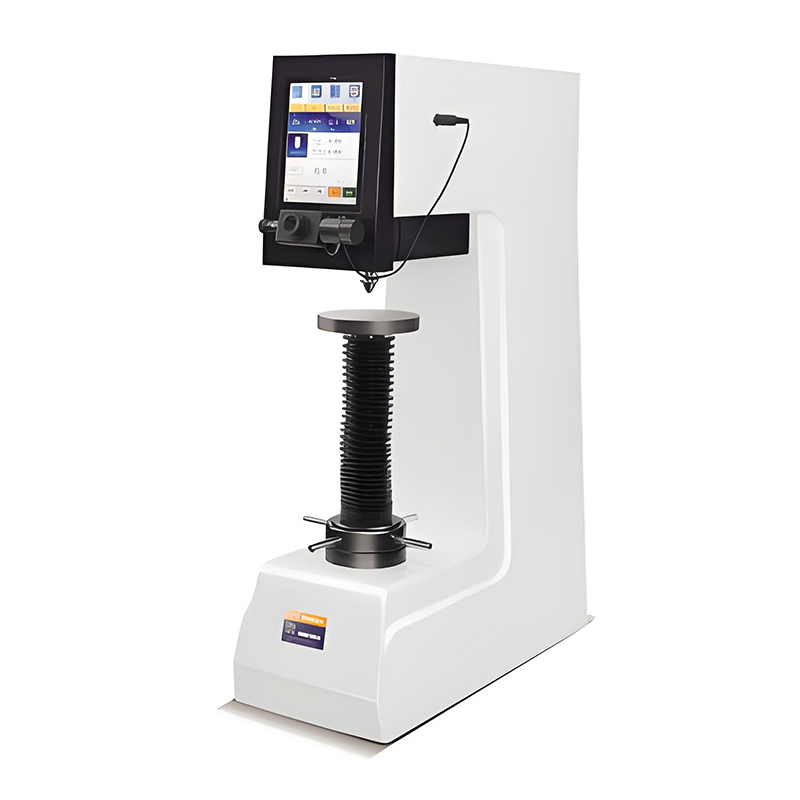
A universal hardness tester is a single instrument engineered to perform multiple standardized hardness test methods, typically Rockwell, Brinell, and Vickers, by swapping indenters, objective lenses, and loading profiles. This eliminates the need for separate dedicated testers. Beyond traditional optical methods, advanced universal machines use depth-sensing technology to measure Martens hardness (HM) and indentation modulus according to ISO 14577. This is achieved by recording the continuous force-displacement curve during the indentation cycle, providing material parameters equivalent to a high-speed compression test. A modern universal machine, for instance, can apply test forces from 1 gf to 3000 kgf, covering the micro, low-load, and macro ranges for Vickers, Brinell, Rockwell, and even Knoop and plastic tests. Closed-loop force control systems, often with a sampling rate of 1 to 2 kHz, ensure that the loading rate and dwell time strictly conform to standards like ASTM E92 and ISO 6506.
Rockwell, Brinell, and Vickers Hardness Test Fundamentals
All three tests quantify a material’s resistance to permanent plastic deformation, but they differ fundamentally in indenter geometry, load application, and measurement principle.
Rockwell Hardness Test
The Rockwell method measures the differential depth of penetration of an indenter under a preliminary minor load followed by a major load. The minor load (typically 10 kgf or 3 kgf) establishes a reference position, absorbing surface imperfections and elastic deformation. The major load (60, 100, or 150 kgf) is then applied and removed, and the permanent increase in penetration depth is measured. The hardness number is inversely related to this depth and is read directly from a dial or digital display. A Rockwell HRC value of 60, for example, corresponds to a depth of approximately 0.080 mm. Common scales include HRC (diamond cone, 150 kgf) for hardened steels and HRB (1/16-inch ball, 100 kgf) for softer alloys. The main advantage is speed, as the result is obtained in seconds without optical measurement.
Brinell Hardness Test
The Brinell test uses a tungsten carbide ball indenter, typically 10 mm in diameter, pressed into the surface with a high test force (commonly 3000 kgf for ferrous metals). After removing the load, the diameter of the permanent impression is measured optically. The Brinell hardness number (HBW) is calculated as the applied load divided by the spherical surface area of the indentation. A typical result is written as 350 HBW 10/3000, indicating a Brinell hardness of 350 using a 10 mm ball and a 3000 kgf load for a dwell time of 10 to 15 seconds. The large indentation averages out local microstructural variations, making Brinell ideal for castings, forgings, and materials with coarse grain structures. It is not suitable for very hard materials (above 650 HBW) or thin sections, as the ball may deform or the sample may be damaged.
Vickers Hardness Test
The Vickers test uses a diamond square-based pyramid indenter with an apex angle of 136 degrees. The principle is identical across the entire load range: the indenter is pressed into the sample under a precise force, and the two diagonals of the resulting square impression are measured optically and averaged. Vickers hardness is reported as HV, followed by the test force in kgf, for example 640 HV 30. The unit for Vickers hardness is technically kgf/mm², but it is conventionally expressed as a dimensionless number. Because the same indenter shape is used for forces from 1 gf to 120 kgf, Vickers is uniquely capable of measuring hardness across scales, from thin foils and case-hardened layers to bulk materials, and the results are generally load-independent above a few hundred grams of force.
Hardness Measurement Units Across Methods
The concept of a "hardness unit" is method-specific. Each test has its own reporting convention, and values are not directly transferable without conversion tables defined by ASTM E140 and ISO 18265. The table below clarifies the unit and scale structure for the main test methods.
| Test Method | Symbol | Physical Unit | Example Designation |
|---|---|---|---|
| Rockwell | HR + Scale | Dimensionless | 60 HRC |
| Brinell | HBW | kgf/mm² | 350 HBW 10/3000 |
| Vickers | HV | kgf/mm² | 640 HV 30 |
| Knoop | HK | kgf/mm² | 1000 HK 0.1 |
| Martens (Universal) | HM | N/mm² | 4500 HM 0.5/20/15 |
Comprehensive Comparison of the Three Methods
The differences between Brinell, Rockwell, and Vickers hardness tests are not just procedural; they determine which method is appropriate for a given industrial task. The following table provides a direct, application-oriented comparison.
| Feature | Rockwell | Brinell | Vickers |
|---|---|---|---|
| Indenter | Diamond cone or carbide ball | 10 mm carbide ball (or 5/2.5 mm) | Diamond pyramid (136 deg) |
| Measurement | Depth of penetration | Diameter of impression | Diagonal of impression |
| Speed | Very fast (3-5 seconds) | Slow (30+ seconds optical) | Moderate to slow |
| Suitability | Production QA, hardened steels, alloys | Castings, forgings, coarse-grained metals | All materials, coatings, thin layers, R&D |
| Key Limitation | Not for thin or case-hardened layers | Not above 650 HBW; large damage area | Slow, surface finish critical |
What Is the Vickers Hardness Test Used For
The Vickers hardness test is the preferred method when a single hardness scale must cover the full range of a product’s material hardness. Its primary applications include case-depth analysis of carburized or nitrided steels, where a series of micro-indentations from the surface edge to the core maps the hardness gradient. A typical specification, such as HV 550 at a case depth of 0.5 mm, can only be verified with a Vickers micro-hardness traverse. The test is also essential for qualifying welds, where the heat-affected zone, base metal, and weld metal each have different properties, and the small indenter can isolate these regions. In research and development, Vickers is used to characterize ceramics, composites, and thin-film coatings where other indenters would shatter or require too large a footprint. For example, a TiN hard coating 3 microns thick can be reliably tested at 0.025 kgf (25 gf), producing an indentation approximately 0.5 microns deep, without influence from the substrate.
Webster vs Rockwell Hardness
The Webster hardness tester is a portable, direct-reading instrument that applies a specific indentation method. It is not directly equivalent to a specific Rockwell scale, but Webster hardness values are empirically correlated to Rockwell B and Rockwell H scales for aluminum alloys. The Webster B scale, for instance, covers roughly from WB 0 to WB 20, which corresponds to approximately 25 to 100 HRB for aluminum extrusions and sheet. The Webster tester’s advantage lies in its portability and ability to test large assemblies, heat exchangers, and aircraft structures that cannot be brought to a bench Rockwell tester. However, the correlation is material-specific. A Webster tester calibrated for 6061-T6 aluminum will not provide accurate Rockwell equivalents for 7075 or for other metals. For precise material certification, a Rockwell or Brinell bench test is required, with the Webster serving as a convenient field-screening tool.
How to Select the Correct Hardness Test for Your Application
The choice of test is driven by material type, sample geometry, production volume, and the required information. The following decision logic, based on practical industrial scenarios, provides a constructive guide.
- For large castings or forgings with coarse microstructures, choose the Brinell test. The 10 mm ball indentation averages grain boundary and phase variations, giving a bulk hardness representative of the component’s overall mechanical properties. A standard test at 3000 kgf with a 10 mm ball is the default for iron and steel castings.
- For high-volume production quality control of machined parts, Rockwell is the standard. A 3-second HRC test can maintain the process capability index of a heat treatment line without creating a bottleneck. Use HRC for hardened steels above 20 HRC and HRB for softer non-ferrous alloys.
- For case-hardened, thin, or coated components, micro-Vickers is the only suitable choice. A load of 500 gf or 1 kgf and a Knoop or Vickers indenter can measure the core-to-case gradient without the indentation extending through the hardened layer.
- For welds, joints, and heat-affected zones, Vickers or Knoop low-force testing (1-5 kgf) can resolve hardness variations across the narrow band of a weld interface, which is critical for avoiding hydrogen cracking or brittle phase formation.
- When material properties beyond a single hardness number are needed, a universal hardness tester in Martens mode provides the indentation hardness, elastic modulus, creep, and relaxation behavior from a single instrumented indentation test, which is valuable for polymer, ceramic, and advanced material development.
Converting Between Hardness Scales
Hardness scale conversions are approximate, and the responsible practice is to use them for comparison only, never for specification. The conversion relationship between Brinell, Rockwell, and Vickers depends on the material’s work-hardening behavior, so an ASTM E140 conversion table for austenitic stainless steel will differ from that for carbon and low-alloy steel. As a practical example, a typical carbon steel with 640 HV 30 corresponds to approximately 56 HRC and 600 HBW. However, for a fully work-hardened austenitic stainless steel, the same 56 HRC might correspond to only 250 HBW. When a specification requires reporting in a specific scale, the test must be performed directly in that scale. A universal hardness testing machine can minimize this uncertainty by performing the test in the required method without resorting to conversion.

