

 English
  Español
  Deutsch

Metallographic pre-processing equipment—comprising the cutting machine, inlay machine, and grinding and polishing machine—forms the foundation of any reliable metallographic analysis workflow. The quality of every downstream observation, whether optical microscopy, scanning electron microscopy, or hardness testing, is directly determined by how well these three preparation stages are executed. A poorly cut sample introduces deformation artifacts; inadequate mounting compromises edge retention; insufficient polishing leaves surface scratches that obscure microstructural features. Understanding the function, specifications, and correct operation of each equipment type enables laboratories and production quality teams to achieve preparation results that consistently meet ASTM E3, ISO 9metallographic preparation standards, and application-specific requirements.
Content
- 1 The Role of Pre-Processing in Metallographic Analysis
- 2 Metallographic Cutting Machine: Extracting Samples Without Damage
- 3 Metallographic Inlay Machine: Mounting Specimens for Reliable Preparation
- 4 Metallographic Grinding and Polishing Machine: Achieving the Mirror Surface
- 5 Integrating the Three Machines Into a Coherent Workflow
- 6 Selecting Metallographic Pre-Processing Equipment for Your Application
The Role of Pre-Processing in Metallographic Analysis
Metallographic analysis—the examination of a material's microstructure to assess grain size, phase distribution, inclusion content, coating thickness, weld quality, and heat treatment response—can only yield accurate results if the sample surface presented to the microscope is a true, artifact-free representation of the bulk material. Pre-processing equipment exists to achieve this condition reliably and reproducibly.
The three-stage pre-processing sequence follows a logical progression:
- Cutting extracts a representative section from the bulk material at the correct location and orientation without introducing thermal damage or mechanical deformation beyond the immediate cut surface.
- Mounting (inlay) encapsulates the cut specimen in a rigid polymer matrix that provides mechanical support during grinding and polishing, preserves edge features, and creates a standardized geometry compatible with automated preparation equipment.
- Grinding and polishing progressively removes material from the specimen surface through a sequence of decreasing abrasive sizes, ultimately producing a scratch-free, mirror-quality surface ready for etching and microscopic examination.
Each stage introduces its own potential for artifact introduction. Studies in metallographic preparation literature indicate that up to 70% of analysis errors originate in the sample preparation stage rather than in microscopy or interpretation—underlining why equipment selection and process control at the pre-processing stage are critical.
Metallographic Cutting Machine: Extracting Samples Without Damage
The metallographic cutting machine is the entry point of the preparation workflow. Its primary engineering challenge is removing a section from a hard, often tough material while generating minimal heat, mechanical stress, and surface deformation in the zone of interest.
Types of Metallographic Cutting Machines
Two primary cutting technologies are used in metallographic laboratories, each suited to different material types and precision requirements:
- Abrasive cut-off machines: Use a rotating abrasive wheel (typically aluminum oxide for ferrous materials or silicon carbide for non-ferrous and ceramics) to section the specimen. Wheel diameters commonly range from 150 mm to 400 mm, with spindle speeds of 2,800–3,500 RPM. Flood coolant systems are essential to control heat generation—inadequate cooling causes a thermally affected zone (TAZ) of 0.5–3 mm depth in steel, producing phase transformations that invalidate near-surface microstructure observations.
- Precision (low-speed) cutting machines: Use a thin diamond wafering blade rotating at 100–500 RPM with minimal cutting force. The low speed and fine blade thickness (typically 0.3–0.5 mm kerf) generate negligible heat and produce a deformation zone of less than 50 µm—compared to 200–500 µm for abrasive cut-off. Precision cutters are essential for ceramics, electronic components, thin coatings, and any application where the cut surface will be examined within 1–2 mm of the cut plane.
Critical Features to Evaluate in a Cutting Machine
- Clamping system rigidity: Specimen movement during cutting produces uneven surfaces and can fracture brittle materials. Vise-type clamps with fine screw adjustment and anti-vibration mounts are preferred over simple toggle clamps for precision work.
- Feed rate control: Manual feed introduces operator variability and increases the risk of wheel overload and thermal damage. Motorized gravity feed or servo-controlled feed systems maintain a consistent cutting force, extending wheel life and improving cut surface quality.
- Coolant system capacity and flow rate: High-volume coolant delivery (typically 8–15 liters/minute for abrasive cut-off machines) is more effective than low-volume spray. Coolant recirculation systems with filtration extend fluid life and reduce operating cost.
- Maximum section capacity: Round bar capacity ranges from 40 mm to over 150 mm diameter depending on machine class. Selecting a machine with capacity significantly exceeding typical sample sizes reduces the risk of wheel binding and thermal overload at the cut zone.
Abrasive Wheel Selection by Material
| Material Category | Recommended Abrasive | Bond Type | Notes |
|---|---|---|---|
| Carbon and alloy steels | Aluminum oxide (Al₂O₃) | Resinoid | Hard bond for soft materials; soft bond for hard steels |
| Stainless steel, Ni alloys | Aluminum oxide (Al₂O₃) | Resinoid (soft grade) | Reduced feed rate recommended to avoid work hardening |
| Aluminum, copper alloys | Silicon carbide (SiC) | Resinoid | Higher coolant flow to prevent loading of soft metals |
| Ceramics, hardmetals | Diamond (wafering blade) | Metal or resin bond | Low-speed precision cutter required |
| Electronic components, PCBs | Diamond (wafering blade) | Resin bond | Precision cutter only; abrasive cut-off will destroy components |
Metallographic Inlay Machine: Mounting Specimens for Reliable Preparation
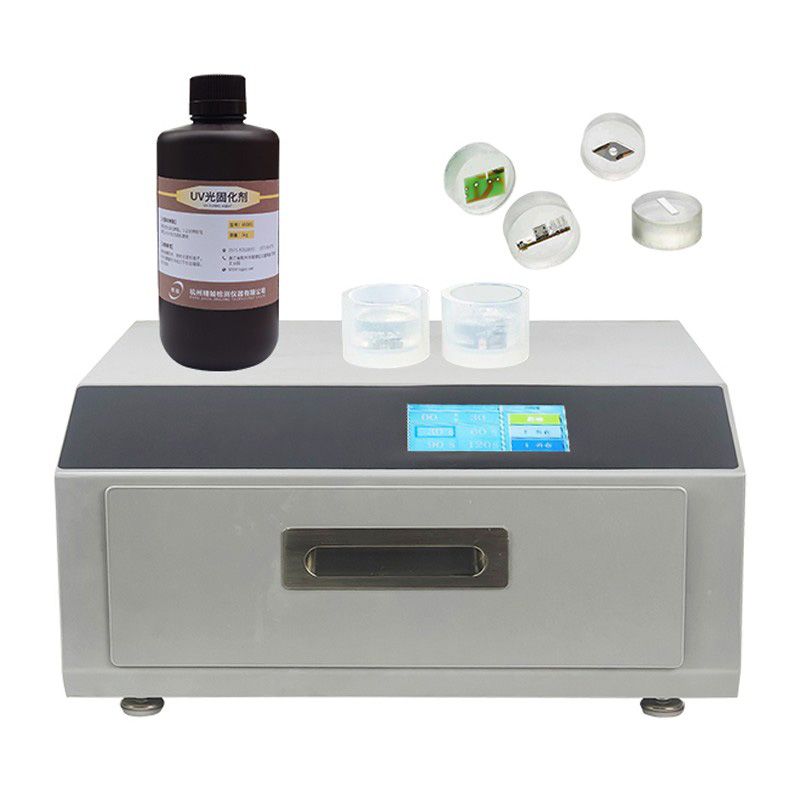
The metallographic inlay machine—also referred to as a mounting press or hot mounting press—encapsulates the cut specimen within a polymer resin to create a standardized, easy-to-handle mount. Mounting serves multiple functions that directly influence the quality of subsequent grinding and polishing stages.
Why Mounting Is Not Optional
- Edge retention: Without support from mounting resin, specimen edges are preferentially removed during grinding, making edge features—coatings, decarburized layers, carburized case depths, weld heat-affected zones—impossible to evaluate accurately. Hard epoxy resins can maintain edge retention to within 5–10 µm of the true edge.
- Standardized geometry: Mounted specimens of consistent diameter (25 mm, 30 mm, 40 mm, and 50 mm are the most common standards) are compatible with automated grinding and polishing machines and specimen holders, enabling batch processing of multiple samples simultaneously.
- Safe handling: Small, sharp, or irregularly shaped specimens are hazardous to handle during extended grinding and polishing sequences. Mounting eliminates handling risks and provides a consistent grip geometry.
- Labeling and traceability: Sample identification can be embedded in or written on the mount, maintaining specimen traceability through the preparation and analysis sequence.
Hot Compression Mounting: Process and Equipment
Hot compression mounting is the most widely used inlay method in production metallographic laboratories. The specimen is placed in the mounting press cylinder with thermosetting or thermoplastic resin powder, and the press applies simultaneous heat and pressure to cure and consolidate the mount.
Typical process parameters for hot mounting:
- Temperature: 150°C–180°C for phenolic (Bakelite) and epoxy resins; 170°C–200°C for acrylic resins
- Pressure: 20–30 kN applied through a hydraulic or mechanical ram, equivalent to approximately 25–35 MPa on a 30mm diameter mount
- Heating time: 4–8 minutes at temperature for most resins
- Cooling time: 3–5 minutes under pressure before ejection, to prevent mount distortion
- Total cycle time: Typically 8–15 minutes per mount depending on resin type and cylinder diameter
Cold Mounting: When Hot Mounting Is Not Suitable
Some specimens cannot tolerate the temperatures required for hot mounting—electronic assemblies, soldered joints, low-melting-point alloys (tin, bismuth, indium-based), and thermally sensitive coatings are common examples. Cold mounting uses two-component epoxy, acrylic, or polyester systems that cure at room temperature without applied pressure.
Cold mounting resins vary significantly in their edge retention performance. Epoxy-based cold mount resins achieve hardness values of 80–90 Shore D, comparable to hot-mounted phenolic, while standard polyester resins typically achieve only 70–75 Shore D—resulting in noticeably poorer edge retention in polishing. Vacuum impregnation systems, available as accessories on some inlay machines, improve cold mount penetration into porous specimens such as powder metallurgy parts, thermal spray coatings, and cast irons.
Mounting Resin Selection Guide
| Resin Type | Mounting Method | Hardness (Shore D) | Edge Retention | Best Applications |
|---|---|---|---|---|
| Phenolic (Bakelite) | Hot compression | 80–85 | Good | General steel and ferrous metallography |
| Diallyl phthalate (DAP) | Hot compression | 85–90 | Excellent | Coatings, case depth, edge-critical work |
| Acrylic (thermoplastic) | Hot compression | 75–80 | Moderate | High-throughput production labs (fast cycle) |
| Epoxy (two-component) | Cold mounting | 80–90 | Excellent | Porous materials, sensitive specimens, vacuum impregnation |
| Polyester (two-component) | Cold mounting | 70–75 | Moderate | Low-budget applications, non-edge-critical bulk analysis |
Metallographic Grinding and Polishing Machine: Achieving the Mirror Surface
The grinding and polishing machine is the most time-intensive piece of pre-processing equipment and the stage where the quality of the final surface is determined. Its function is to progressively remove material from the mounted specimen surface through a controlled sequence of abrasive steps, each eliminating the damage introduced by the previous step, until a scratch-free, deformation-free surface is achieved.
Machine Configuration: Single vs Automated Multi-Station
Grinding and polishing machines are available in two broad configurations:
- Single-wheel manual or semi-automatic machines: Feature one rotating platen (200–300 mm diameter) on which the operator manually changes abrasive papers or polishing cloths between steps. Suitable for low-volume laboratories, research environments, or specialized materials requiring non-standard preparation sequences. Platen speeds typically range from 50–600 RPM.
- Multi-station automated systems: Feature 2–3 platens and a motorized specimen head that holds 3–6 mounted specimens simultaneously in a carrier. The head applies controlled downforce (typically 5–50 N per specimen), rotates specimens relative to the platen, and moves automatically between stations on programmed sequences. These systems deliver significantly higher reproducibility than manual preparation—inter-operator variability in surface roughness measurements is reduced from ±30–40% to ±5–8% in comparative studies.
The Grinding and Polishing Sequence
A standard preparation sequence for medium-hardness steel (HV 200–400) proceeds through the following stages:
- Planar grinding (P120–P320 SiC paper): Establishes a flat, co-planar surface across all specimens in the holder. Removes saw marks and gross surface irregularities. Typically 30–60 seconds at 300 RPM with water lubrication.
- Fine grinding (P800–P2500 SiC paper or 9 µm diamond on rigid disc): Removes the deformation layer from planar grinding. Each step should eliminate all scratches from the previous step before proceeding. Water or oil lubricant depending on paper or disc type.
- Diamond polishing (3 µm and 1 µm diamond suspension on polishing cloth): Removes fine grinding marks and begins revealing microstructural features. MD-Mol or similar semi-rigid cloths are standard for this stage.
- Final polishing (0.05 µm colloidal silica or alumina on short-nap cloth): Produces a deformation-free, scratch-free surface. Colloidal silica combines chemical and mechanical action, particularly effective for aluminum alloys, stainless steels, and titanium.
Key Machine Parameters and Their Effect on Result Quality
| Parameter | Typical Range | Effect of Too Low | Effect of Too High |
|---|---|---|---|
| Platen speed (RPM) | 150–300 RPM (grinding); 100–150 RPM (polishing) | Slow material removal; long preparation times | Excess heat; smearing of soft phases; relief |
| Applied force per specimen | 15–30 N (grinding); 10–20 N (polishing) | Inadequate scratch removal; extended step times | Edge rounding; deformation of soft materials |
| Specimen head rotation direction | Contra-rotation (opposite to platen) | Uneven surface; comet tailing on inclusions | N/A (contra-rotation is the preferred setting) |
| Lubricant/coolant flow | Continuous water (grinding); suspension dosing (polishing) | Clogged abrasive; heat buildup; scratching | Diluted suspension; reduced polishing efficiency |
Integrating the Three Machines Into a Coherent Workflow
The three pieces of metallographic pre-processing equipment are interdependent—the output quality of each stage sets the constraints for the next. Optimizing each machine in isolation without considering workflow integration leads to bottlenecks, quality inconsistencies, and unnecessary consumable costs.
- Cut quality governs grinding time: A thermally damaged cut surface with a 2–3 mm affected zone requires significantly more material removal during planar grinding than a precision-cut surface with a 50 µm deformation zone. A precision cutting investment often reduces consumable cost at the grinding stage by 30–50% in high-hardness material applications.
- Mount hardness determines polishing outcome: A mount that is significantly softer than the specimen (e.g., polyester resin on a hardmetal specimen) causes relief polishing, where the hard specimen protrudes above the surrounding resin surface. This produces a rocking effect under the microscope objective and distorts focus across the field of view.
- Specimen geometry from mounting affects grinding uniformity: Specimens mounted with the examination surface non-perpendicular to the mount axis produce uneven grinding, with one edge preferentially removed. Precision mounting with a specimen positioning fixture in the inlay machine eliminates this variability.
For laboratories processing more than 20–30 specimens per day, investment in automated grinding and polishing with compatible standardized mounts from a defined inlay machine becomes economically justified. Automated systems reduce preparation labor time per specimen by 40–60% compared to fully manual preparation while simultaneously improving surface quality consistency.
Selecting Metallographic Pre-Processing Equipment for Your Application
Equipment selection should be driven by the specific material range, sample throughput, required analysis types, and available budget. The following framework covers the primary decision criteria:
- Material hardness range: Laboratories working exclusively with soft metals (aluminum, copper, HV < 150) can use standard abrasive cut-off, phenolic mounting, and SiC paper-based grinding sequences. Laboratories working with hardmetals, ceramics, or coatings above HV 1000 require precision cutting, hard DAP or epoxy mounting, and diamond-based grinding and polishing throughout.
- Throughput requirements: Research laboratories processing 2–5 specimens per day can use manual preparation throughout. Production quality control laboratories processing 15+ specimens per shift should evaluate semi-automatic or fully automatic grinding and polishing systems with compatible inlay press cycle times.
- Edge retention criticality: Coating thickness measurement, case depth analysis, and weld HAZ evaluation all require edge retention as a primary quality criterion. These applications justify the investment in harder mounting resins (DAP or hard epoxy) and fine abrasive cut-off or precision cutting.
- Compliance requirements: Laboratories operating under ASTM E3, ISO 17025 accreditation, or automotive IATF 16949 quality systems require documented, validated preparation procedures with traceable equipment calibration records. Automated machines with data logging capability simplify compliance documentation compared to manual systems.

