

 English
  Español
  Deutsch
Polishing is the final quality gate in metallographic sample preparation. A few residual scratches can hide pearlite lamellae, confuse porosity with pull-out, or turn a clean inclusion analysis into a puzzle. When the goal is a scratch-free surface, metallographers usually compare two abrasives: diamond suspension and alumina polishing slurry. Each has its own cutting mechanism, optimal cloth, particle size range, and cost profile. This guide breaks down their differences and helps you decide which one fits your material and workflow.
Content
- 1 The Two Polishing Media, Explained
- 2 Diamond Suspension: Strengths and Limitations
- 3 Alumina Polishing Slurry: Strengths and Limitations
- 4 Side-by-Side Comparison
- 5 Which Yields More Reliable Scratch-Free Samples?
- 6 Best Practices That Prevent Scratches
- 7 Frequently Asked Questions
- 7.0.1 Q1: Can I combine diamond suspension and alumina slurry on the same specimen?
- 7.0.2 Q2: Why do I still see scratches after alumina slurry polishing?
- 7.0.3 Q3: Is diamond suspension always better than alumina slurry?
- 7.0.4 Q4: What particle size sequence gives the most reliable scratch-free surface?
- 8 Final Thoughts
The Two Polishing Media, Explained
What Is Diamond Suspension?
Diamond suspension is a dispersion of monocrystalline or polycrystalline diamond particles in a water-, alcohol-, or oil-based carrier. Diamond is the hardest known abrasive (Mohs hardness 10), so it cuts efficiently across almost every metallographic material. Particle sizes commonly range from 9 µm down to 0.25 µm, covering both intermediate and final polishing stages. Diamond suspension is known for high removal rates, excellent flatness, and minimal edge rounding, which makes it the default choice for multi-phase alloys, coatings, carbides, and ceramics.
What Is Alumina Polishing Slurry?
Alumina polishing slurry is a water-based suspension of aluminium oxide (Al2O3) particles. Alpha alumina is blocky and harder, while gamma alumina is softer and finer; both are available as powders or ready-to-use slurries. Alumina has been used for decades as a final polishing medium for ferrous alloys. On a napped cloth, a fine alumina slurry can produce a bright, scratch-free surface on low-carbon and medium-carbon steels, cast iron, and many non-ferrous metals. Its lower hardness also makes it gentler on soft materials, but its slower cutting action limits it to the final step.
Diamond Suspension: Strengths and Limitations
Diamond suspension is the standard intermediate polish in metallography and is increasingly used for the final step as well. Its advantages explain why:
- High and stable cutting rate - diamond particles stay sharp and cut steadily, reducing the risk of surface deformation.
- Excellent flatness - hard diamond particles support the specimen and preserve planar surfaces across hard and soft phases.
- Superior edge retention - edges and mounted interfaces remain sharp, which is essential for coating thickness measurement and diffusion layer analysis.
- Broad material compatibility - suitable for steels, aluminium, copper, titanium, nickel alloys, ceramics, carbides, and composites.
- Predictable scratch pattern - well-graded diamond on the right napless cloth leaves a uniform surface with very low scratch density.
- Higher cost - diamond suspension is more expensive per litre than alumina slurry.
- Carrier cleanliness - oil-based diamond suspensions require a solvent rinse before etching; even water-based types must be cleaned thoroughly.
When precise, waste-free abrasive application matters, a diamond spray or polishing paste offers the same high-quality diamond abrasive in a convenient format.
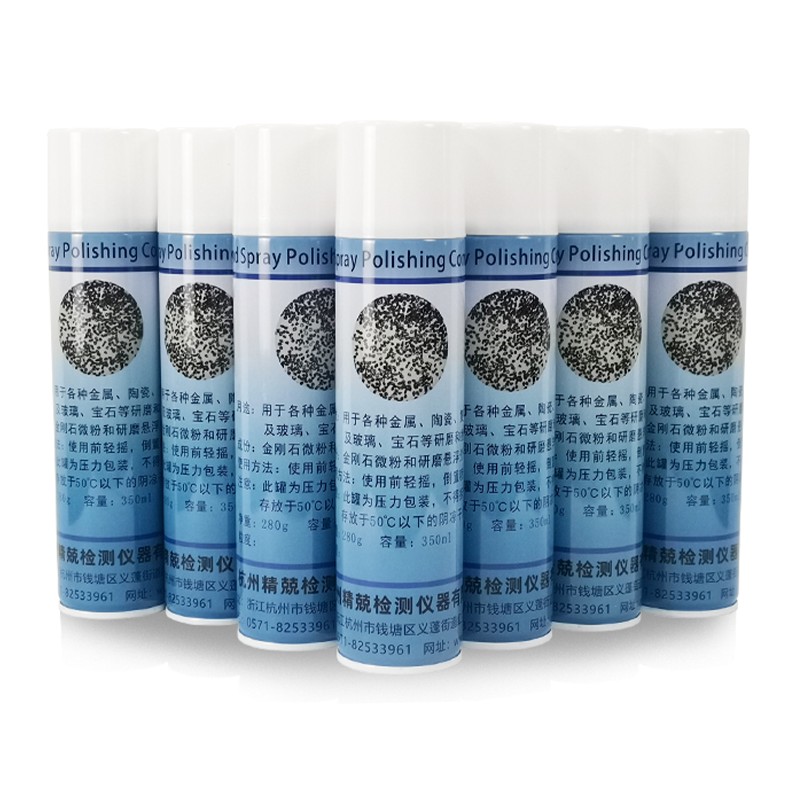 Diamond Spray and Polishing Paste for Precision Metallographic FinishingThis product offers diamond abrasive in spray or paste form for precise, waste-free application. With particle sizes from W0.5 to W10, it suits ultra-precision polishing of high-hardness materials and is highlighted as a convenient alternative before alumina slurry use.View Product →
Alumina Polishing Slurry: Strengths and Limitations
Alumina slurry remains a workhorse in many metallurgical laboratories, especially for final polishing of steels. Its strengths and limits are equally clear:
- Excellent finish on ferrous alloys - 0.3 µm or 0.05 µm alumina produces a bright, scratch-free surface on carbon steels and cast iron.
- Low operating cost - alumina is inexpensive, so final polishing can be repeated or extended without budget concerns.
- Gentle action on soft metals - lower hardness than diamond reduces smearing and mechanical damage on pure aluminium, copper, and tin.
- Water-based workflow - easy to rinse and clean; no organic solvents are required.
- Agglomeration risk - dried or old slurry forms hard clusters that act as coarse abrasive and cause deep scratches.
- Edge rounding and relief - on napped cloths, alumina can round edges and create relief between hard and soft constituents.
- Slow material removal - alumina should not be used for material removal from ground surfaces; it is a final-polish medium only.
For many laboratories, alumina slurry is the finishing touch after a complete diamond sequence.
Side-by-Side Comparison
The table below summarises the key properties that affect scratch-free results.
| Parameter | Diamond Suspension | Alumina Polishing Slurry |
|---|---|---|
| Mohs hardness | 10 | 9 |
| Typical particle sizes | 9, 6, 3, 1, 0.25 µm | 1, 0.3, 0.05 µm |
| Removal rate | High | Low to moderate |
| Edge retention | Excellent | Moderate |
| Flatness and relief control | Excellent | Good, slight relief possible |
| Matching cloth | Napless cloth for fine stages | Napped cloth for final polish |
| Cost per litre | Higher | Lower |
| Best preparation stage | Intermediate to final | Final polish only |
Both media have a clear role in a robust preparation workflow. For a deeper technical breakdown of alumina, diamond, and silicon dioxide polishing liquids, see our complete guide to polishing liquids for metallographic preparation.
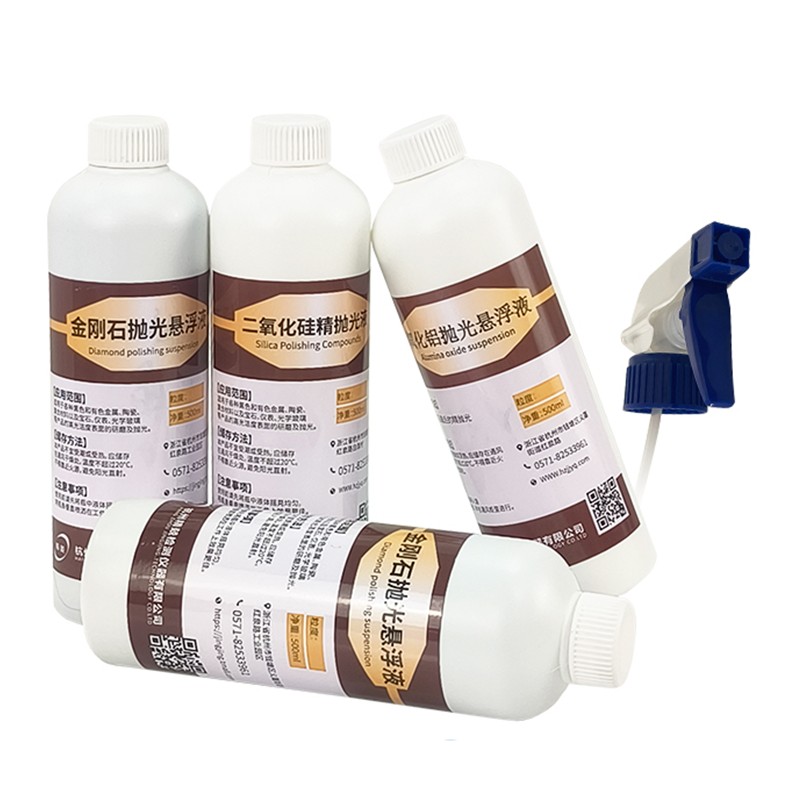 Alumina, Diamond, and Silicon Dioxide Polishing Liquid for Multiple MaterialsA versatile polishing liquid combining alumina, diamond, and silicon dioxide abrasives in 0.02–7.0μm sizes. It is positioned between diamond spray and polishing cloth discussions, emphasizing control for scratch-free surfaces on diverse materials, with bottles available in 200ml and 500ml.View Product →
Which Yields More Reliable Scratch-Free Samples?
Diamond suspension is the more reliable choice when the priority is a scratch-free surface on a broad range of materials. The reason is control: diamond grades are tightly classified, the abrasive keeps cutting efficiently within consistent time windows, and the combination of diamond with the correct napless cloth produces a very uniform surface. For ferritic and pearlitic steels, however, a fine alumina slurry on a proper napped cloth can give equally scratch-free results at a lower cost. The decision therefore depends on your specimen mix and preparation strategy.
The shortest path to scratch-free samples is not a single abrasive but a sequence: coarse diamond removes deformation, fine diamond restores flatness, and a final alumina or fine diamond step removes the last scratches without creating new ones.
- Choose diamond suspension when you prepare hardened or tool steels, carbides, ceramics, coatings, composites, or samples with critical edge requirements, and when intermediate polishing must cut fast with minimal relief.
- Choose alumina slurry when you need an economical final polish for plain carbon steels, cast irons, or soft non-ferrous metals, and when a water-based workflow is preferred.
Best Practices That Prevent Scratches
Whichever abrasive you use, scratches usually come from process errors rather than from the abrasive itself. Follow these rules for consistently clean surfaces:
- Prepare a flat, uniformly ground surface first. Deep deformation from coarse grinding must be removed before polishing begins; otherwise, polishing only elongates existing scratches.
- Use the right cloth for each abrasive. Napless cloths hold diamond firmly and prevent rolling; napped cloths carry alumina slurry and buff the final surface.
- Keep each cloth dedicated to one stage. Cross-contamination from a coarse stage is a classic scratch source that appears only at the microscope.
- Control load, speed, and time. Moderate pressure is ideal, and over-polishing should be avoided because extra time increases relief and introduces random scratches.
- Clean the specimen between every stage. A short ethanol rinse with compressed air drying removes loose abrasive that would otherwise drag across the surface.
- Replace cloth and refresh abrasive regularly. A loaded or glazed cloth cannot hold a fresh charge, and old suspension or slurry develops agglomerates that scratch.
The polishing cloth is just as important as the abrasive: a correct nap structure keeps the suspension active across the whole contact area. Quality polishing cloths are produced with different nap structures for diamond and alumina stages, and selecting the right one directly affects scratch density.
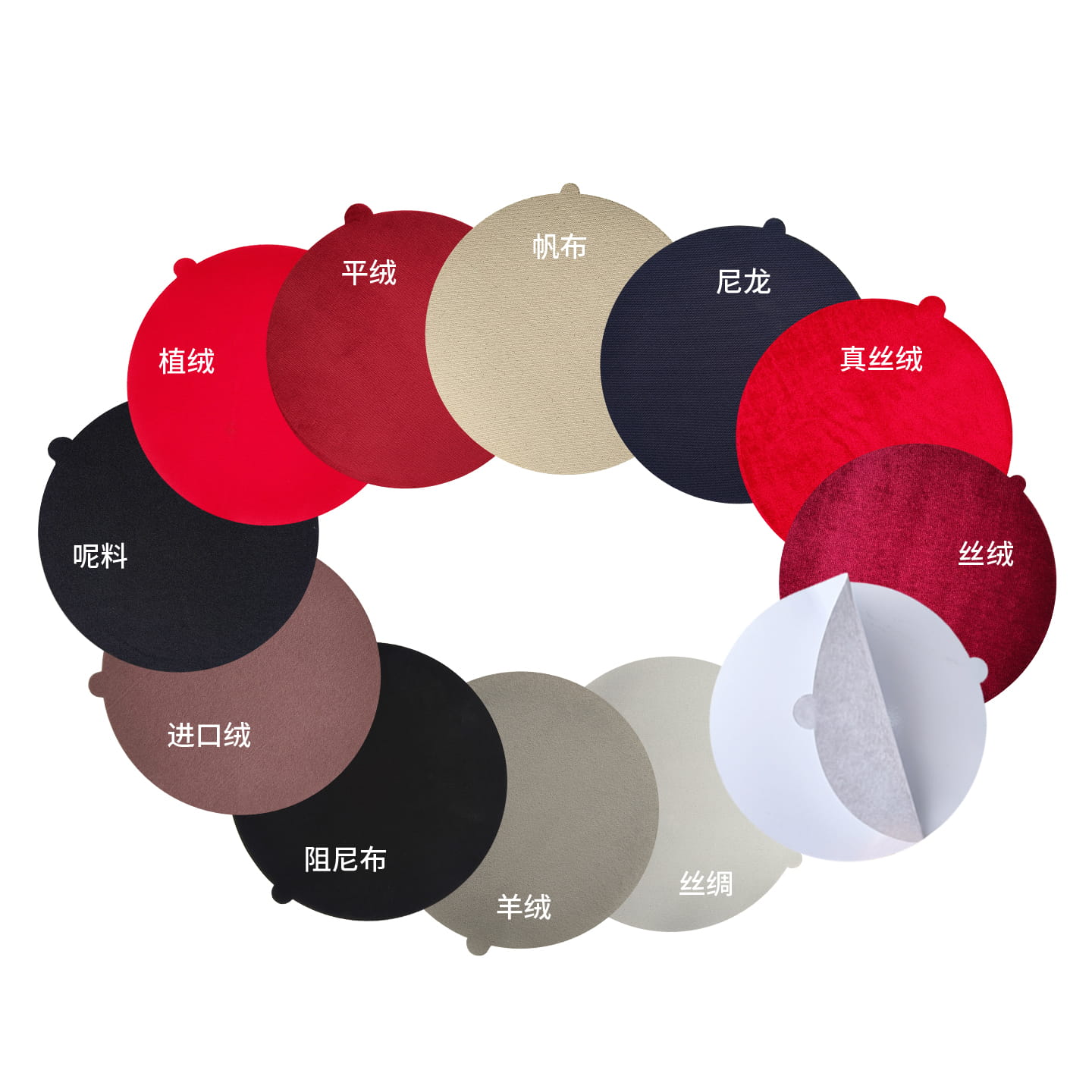 Metallographic Polishing Cloths in Various Materials and SizesThis range of polishing cloths from 200mm to 300mm includes velvet, canvas, silk, wool, and more. The surrounding text notes that correct nap structure is critical for abrasive performance, making these cloths essential for achieving scratch-free mirror finishes during final polishing stages.View Product →
Frequently Asked Questions
Q1: Can I combine diamond suspension and alumina slurry on the same specimen?
Yes, and this is a common practice. The usual sequence is 3 µm diamond, 1 µm diamond, then a final polish with 0.05 µm alumina on a napped cloth. Between stages, clean the specimen and use a different cloth to avoid cross-contamination.
Q2: Why do I still see scratches after alumina slurry polishing?
Agglomerated particles in old or dried slurry are the most common cause. Other causes include a contaminated or glazed cloth, excessive load, and polishing for too long. Use fresh slurry, a clean napped cloth, and moderate pressure.
Q3: Is diamond suspension always better than alumina slurry?
No. Diamond suspension offers better control, flatness, and edge retention, but alumina slurry is cheaper and can produce excellent scratch-free surfaces on plain steels. For samples with high hardness differences or sharp edges, diamond is preferable; for routine ferrous samples, alumina is often sufficient.
Q4: What particle size sequence gives the most reliable scratch-free surface?
Start with 3 µm diamond on a napless cloth, continue with 1 µm diamond, and finish with either 0.25 µm diamond or 0.05 µm alumina. Each step must be long enough to remove damage from the previous one but short enough to avoid relief.
Final Thoughts
Both diamond suspension and alumina polishing slurry are legitimate tools in metallographic sample preparation. Diamond suspension gives you more control over flatness, edge retention, and scratch density across a wide material range, which makes it the safest default for demanding quality-control and research samples. Alumina slurry remains a low-cost, water-compatible finishing medium for ferrous alloys and soft metals. To achieve truly scratch-free samples, focus on the full system: correct abrasive size, matched cloth, controlled pressure, fresh consumables, and disciplined cleaning between stages. A complete range of polishing liquids, diamond sprays, pastes, and polishing cloths is available to support every step of that workflow.

