

 English
  Español
  Deutsch

Selecting a metallographic microscope is rarely a simple specification exercise. For a quality laboratory, the choice between an upright and an inverted architecture affects not only image quality, but also daily ergonomics, sample preparation workload, and the range of materials you can examine efficiently. Both designs have served metallurgists and materials engineers for decades, yet each solves a fundamentally different set of practical problems. This guide compares the two architectures across the criteria that matter most in a production-oriented quality lab, helping you make a confident purchasing decision.
Content
- 1 Understanding the Two Microscope Architectures
- 2 Upright Metallographic Microscopes at a Glance
- 3 Inverted Metallographic Microscopes at a Glance
- 4 Head-to-Head Comparison: Upright vs. Inverted
- 5 Sample Preparation, Ergonomics, and Throughput
- 6 Optical Performance and Illumination Strategies
- 7 A Practical Decision Framework for Your Quality Lab
- 8 Frequently Asked Questions
- 8.0.1 Q1: Can an inverted microscope inspect small mounted specimens?
- 8.0.2 Q2: Are upright microscopes more affordable than inverted ones?
- 8.0.3 Q3: Do I need a complete specimen preparation line to benefit from an inverted microscope?
- 8.0.4 Q4: Which architecture is better for automated image analysis?
- 8.0.5 Q5: Can one system satisfy both upright and inverted requirements?
Understanding the Two Microscope Architectures
An upright metallographic microscope positions the objective lens above the specimen stage. The light path travels downward and illuminates the prepared surface, which faces upward. The operator inspects the specimen through eyepieces or a digital camera port located above the stage.
An inverted metallographic microscope reverses this layout. The objectives are mounted beneath the stage, and the prepared face of the specimen faces downward, resting directly on the glass stage plate. The light path travels upward through the objective, which is why the inverted design is sometimes called a bottom-up optical arrangement.
Upright Metallographic Microscopes at a Glance
Upright metallographic microscopes place the objective above the stage and direct the light path onto the top surface of the specimen. For laboratories handling small and flat samples, this familiar geometry is both simple to operate and easy to maintain.
Where It Works Best
Thin sheets, wafers, small mounted coupons, and coated components can be placed directly on the mechanical stage and leveled in seconds. The unobstructed access from above makes it easy to insert polarizers, DIC prisms, or darkfield stops, and oil-immersion objectives are straightforward to clean.
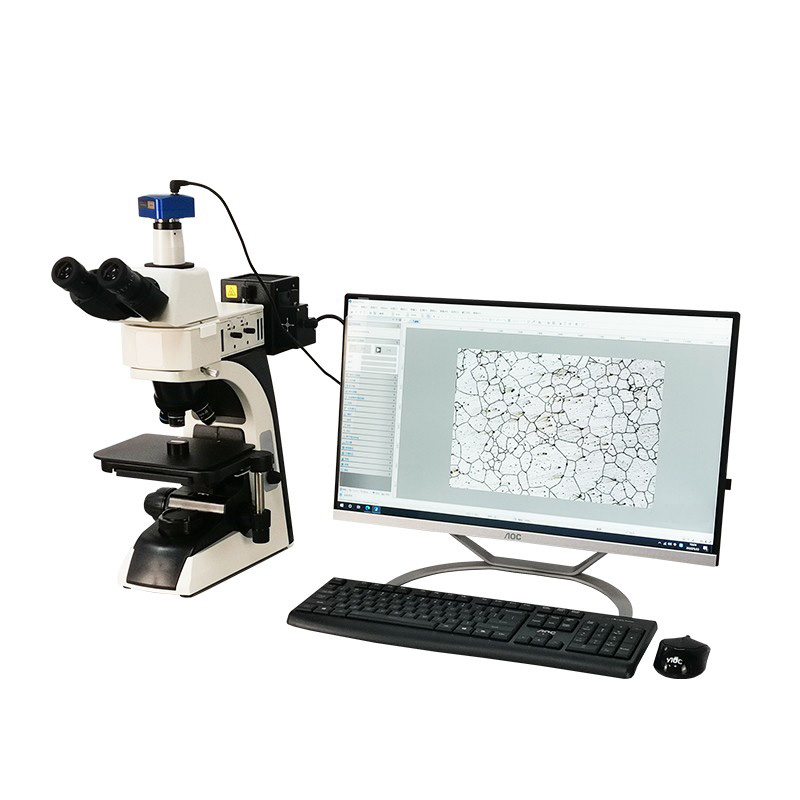 ML8000 Upright Metallographic Microscope with Reflected and Transmitted LightThis upright microscope suits thin sheets, wafers, and small mounted coupons that can be leveled on a mechanical stage. Its bright/dark field objectives and easy access for DIC or polarizers make it a practical choice for routine material inspection.View Product →
Where It Struggles
Large, heavy, or irregular specimens are difficult to position beneath an upright objective. Any lack of parallelism between the specimen back and the stage causes focus drift, so the operator must cut or mount the sample first, which adds preparation time and can reduce throughput. If most of your workload is small and flat, the upright route is worth serious consideration. Our guide to choosing the right upright metallographic microscope covers the objective ranges, illumination modes, and stage features to evaluate.
Inverted Metallographic Microscopes at a Glance
An inverted metallographic microscope mounts the objectives below the stage and accepts the specimen face-down. This bottom-up architecture is widely preferred in industrial quality laboratories because it simplifies specimen handling and protects the optical system.
Where It Works Best
Heavy castings, forgings, heat-treated components, and irregularly shaped parts can be placed directly on the stage without clamps or leveling fixtures. The specimen's own weight keeps the prepared face flush against the stage, so the focal plane remains stable even for large parts. The objectives are shielded beneath the stage from polishing debris and immersion oil.
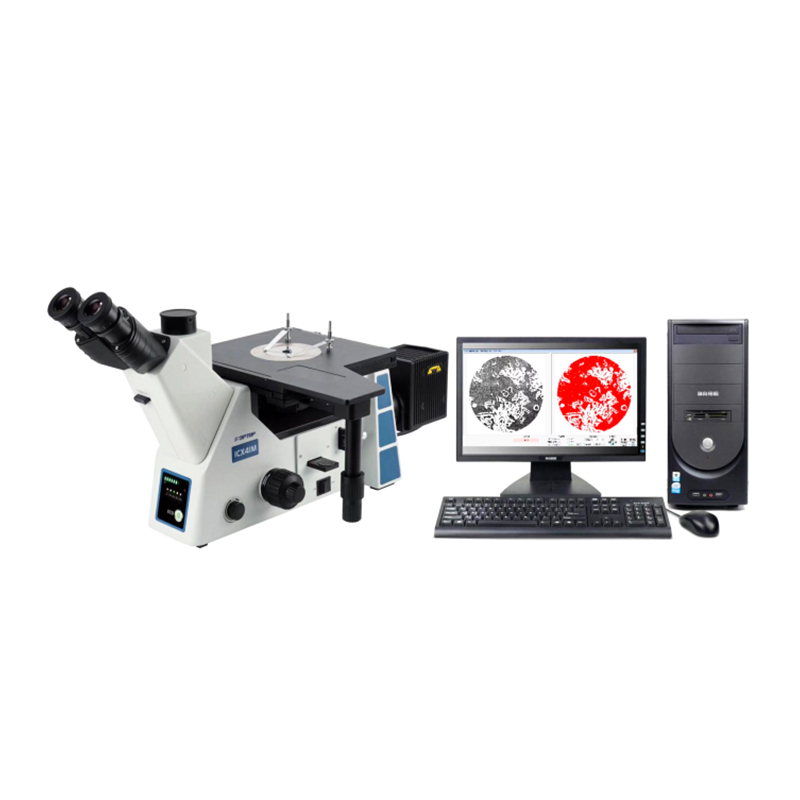 ICX41M Inverted Metallographic Microscope for Large SpecimensDesigned for heavy or irregular parts, this inverted microscope keeps samples stable under their own weight. With 5X–100X magnification, a large mechanical stage, and ergonomic viewing angles, it supports efficient industrial metallurgical analysis.View Product →
Where It Struggles
Inverted systems are less convenient for very thin foils or flexible materials, which may not rest flat against the stage, and transmitted-light techniques are harder to implement than on an upright frame. For typical metallurgical work, however, these limitations rarely matter. To understand why this architecture has become an essential tool in modern materials laboratories, read our article on the inverted metallographic microscope.
Head-to-Head Comparison: Upright vs. Inverted
The comparison table below summarizes the practical differences across the factors that most directly affect laboratory productivity and operator comfort.
| Comparison Factor | Upright Architecture | Inverted Architecture |
|---|---|---|
| Objective position | Above the stage | Below the stage |
| Specimen orientation | Prepared face up | Prepared face down |
| Ideal specimen type | Thin, flat, small | Large, heavy, irregular |
| Leveling requirement | Usually required | Minimal |
| Objective protection | Exposed above stage | Shielded below stage |
| Preparation workload | Often needs cutting or mounting | Can often inspect unmounted surfaces |
| Operator ergonomics | Forward reach, possible neck strain | Comfortable top loading |
| Typical settings | Small-part QC, coatings, education | Production QC, failure analysis, high volume |
Sample Preparation, Ergonomics, and Throughput
Throughput is rarely determined by optics alone; it depends heavily on how easily operators can load, focus, and switch specimens. Upright systems require the back of the specimen to be flat and parallel to the observation face. If the sample is too large or oddly shaped, it must be cut or mounted first. Inverted systems relax this requirement: as long as the prepared face is flat, the opposite side can be rough, curved, or irregular, because the specimen merely rests on the stage.
Consistent sample preparation remains essential in both cases. A dependable grinding and polishing routine produces the scratch-free, deformation-free surface that accurate microstructure analysis demands. Laboratories building a complete metallographic workflow often pair the microscope with a stable preparation platform, such as the PG series grinding and polishing machines, to deliver repeatable surface quality across batches and different operators.
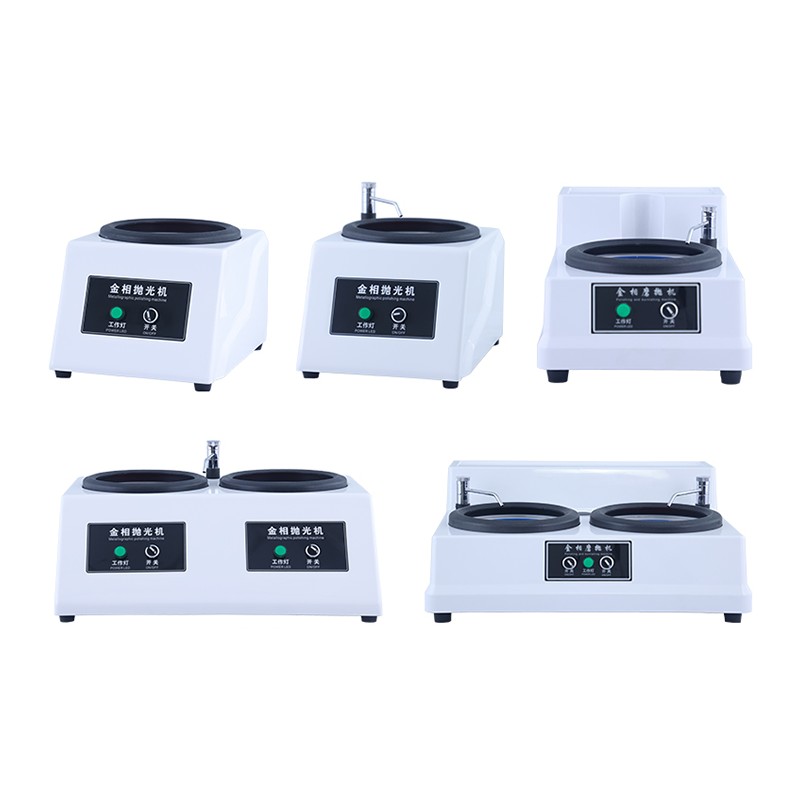 PG Series Metallographic Grinding and Polishing MachineThis PG series grinder-polisher pairs with inverted or upright microscopes to produce consistent, scratch-free surfaces. Models range from single-head to dual-speed with cooling, offering repeatable sample preparation for reliable metallographic examination.View Product →
Ergonomics also favor the inverted layout in most high-volume environments. With an upright microscope, operators frequently lean forward to look through eyepieces while manipulating samples around the objective. With an inverted microscope, the stage is fixed at a comfortable height, and the focal plane is stable regardless of specimen weight. Over a full shift, these factors translate into measurable reductions in fatigue and a lower risk of accidental objective contact.
Optical Performance and Illumination Strategies
Both architectures can deliver excellent brightfield, darkfield, polarized light, and differential interference contrast. The practical difference lies in how easily each mode is implemented with real-world specimens.
With an upright microscope, the specimen must remain perfectly flat; any tilt caused by an uneven back surface produces uneven illumination and focus gradients. With an inverted microscope, the weight of the specimen presses the prepared face against the stage, keeping the focal plane stable even for large parts. This makes the inverted design more forgiving for reflected-light inspection in a production environment.
Digital imaging is equally mature on both platforms. Modern systems provide camera ports, motorized focusing, and automated analysis software for grain-size rating, inclusion evaluation, and coating thickness measurement. When comparing systems, verify that the imaging package supports the specific test standards your quality lab must follow.
A Practical Decision Framework for Your Quality Lab
The best architecture for your quality lab depends on your specimen population, preparation workflow, and operator preferences. Use these five questions to structure your evaluation.
- What is your dominant specimen type? Large, heavy, or irregular samples point toward an inverted system; small, flat, or pre-mounted samples can be handled efficiently by an upright system.
- How much preparation time can you spend per batch? Inverted observation often eliminates the mounting step, saving several minutes per specimen in high-volume laboratories.
- What throughput is required per shift? If operators inspect dozens of parts daily, the faster loading cycle of an inverted stage becomes a significant advantage.
- Which contrast modes do your test methods require? Confirm that the selected platform offers the brightfield, darkfield, DIC, or polarized capabilities specified by your internal or customer standards.
- Will the system support future automation? Motorized stages, autofocus, and digital image analysis are increasingly common; choose an architecture with a clear upgrade path.
Default recommendation: Choose an inverted metallographic microscope when samples are mostly medium to large, heavy, irregular, or processed in high volume. Choose an upright system when small, flat, pre-mounted specimens dominate the workflow.
Frequently Asked Questions
Q1: Can an inverted microscope inspect small mounted specimens?
Yes. Small mounted samples rest face-down on the stage and are inspected just as easily as larger parts, provided the mount has a flat bottom surface.
Q2: Are upright microscopes more affordable than inverted ones?
Price differences depend more on objective quality, illumination options, and stage features than on the architecture itself. Entry-level models are available in both categories.
Q3: Do I need a complete specimen preparation line to benefit from an inverted microscope?
No, but well-prepared specimens improve results on either architecture. Grinding and polishing consistency is just as important as microscope optics for accurate microstructure evaluation.
Q4: Which architecture is better for automated image analysis?
Both support digital cameras and motorized stages. Inverted systems are often easier to automate because specimens remain stable on the stage and no manual leveling is needed before scanning.
Q5: Can one system satisfy both upright and inverted requirements?
Some hybrid inspection systems exist, but most quality laboratories choose one primary architecture based on their dominant sample type and then use dedicated accessories to handle special cases.

