

 English
  Español
  Deutsch

Choosing an abrasive cut-off wheel is not just a matter of picking a diameter that fits your saw. The hardness of the material to be cut is the most important variable in the selection process, because it decides how quickly the abrasive grains dull and how soon the bond must release them. Get the combination wrong, and the wheel burns the workpiece, glazes over, or wears down too fast.
This guide explains the selection logic in practical terms: how material hardness controls the bond grade, how to choose the abrasive grain and grit size, and how to match the wheel to the cutting machine and working conditions.
Content
- 1 Why Material Hardness Determines Wheel Bond Grade
- 2 Select the Abrasive Grain Type
- 3 Grit Size, Structure, and Wheel Dimensions
- 4 Match the Wheel to the Machine and Cutting Conditions
- 5 Safety and Operating Guidelines
- 6 Frequently Asked Questions
- 6.0.1 Q1: Why does a hard material need a soft-bonded cut-off wheel?
- 6.0.2 Q2: Can one cut-off wheel cut all metals?
- 6.0.3 Q3: What should I do if the wheel glazes on stainless steel?
- 6.0.4 Q4: Which is better, a thin or a thick cut-off wheel?
- 6.0.5 Q5: How do I verify that a wheel matches my machine speed?
Why Material Hardness Determines Wheel Bond Grade
Abrasive cut-off wheels consist of abrasive grains held together by a bond, normally a resinoid, rubber, or metal matrix. The bond has two jobs: it holds each grain firmly enough to perform useful cutting work, and it wears away progressively so that fresh, sharp grains are exposed. The bond grade, also called bond hardness, describes how strongly the wheel resists this wear.
When the workpiece is hard, such as hardened steel or a nickel-based alloy, the cutting edges of the grains break down quickly. If the bond is too hard, those dull grains stay in place long after they have lost their cutting ability, producing friction, heat, glazing, and a burned cut edge. A softer bond wears back in time and exposes new sharp grains before the cut becomes inefficient, at the price of a higher wheel consumption rate.
The reverse is true for soft materials. Aluminum, copper, brass, and mild steel dull conventional grains slowly, so each grain stays effective for a long time. A soft bond would release those grains too early, wasting the wheel and giving an inconsistent cut; a harder bond keeps them working and extends wheel life.
Bond grade appears as a letter in the standard wheel marking. In a code such as A 46 Q BF, A is the abrasive type, 46 is the grit size, Q is the bond grade, and BF is the bond type. Letters run from A, softest, to Z, hardest, so D–I is the soft band, J–P the medium band, and Q–Z the hard band.
| Workpiece group | Typical materials | Recommended bond grade |
|---|---|---|
| Very soft | Aluminum, copper, brass, plastics | Hard (Q–Z) |
| Soft to medium | Mild steel, low-carbon steel | Medium-hard (N–R) |
| Medium | Structural steel, general fabrication | Medium (J–P) |
| Hard | Tool steel, die steel, hardened parts | Soft (D–I) |
| Extremely hard or tough | Titanium, Inconel, high-nickel alloys, tungsten carbide | Very soft (D–F) plus ceramic or superabrasive grain |
Use the table as a starting point. If the wheel wears too quickly, move one or two letters harder; if it burns or glazes, move one or two letters softer.
Select the Abrasive Grain Type
The abrasive grain performs the actual cutting, and each grain type works best in a limited hardness range. Brown fused alumina (A) is the standard for carbon steel. Zirconia alumina (ZA) and ceramic alumina are tougher, self-sharpen at the micro-edge, and handle stainless steel, titanium, and nickel-based alloys without burning. Silicon carbide (C or GC) is harder but more brittle; it suits cast iron, cemented carbides, ceramics, and stone.
| Abrasive grain | Recommended workpieces | Hardness range |
|---|---|---|
| Brown fused alumina (A) | Carbon steel, low-alloy steel | Soft to medium |
| Zirconia alumina (ZA) | Stainless steel, high-alloy steel | Medium to high |
| Ceramic alumina (SG) | Titanium, Inconel, high-nickel alloys | High and tough |
| Silicon carbide (C / GC) | Cast iron, carbide, ceramics, stone | Hard and brittle |
| Diamond or CBN | Tungsten carbide, hardened tool steel | Extremely hard |
In metallographic sample preparation, the same hardness rules apply, but the goal is a low-deformation cut surface with minimal heat and burr. The cutting disc must be matched to the sample hardness exactly as a metallographic cutting consumables supplier would when building a complete lab package. Resin-bond discs cover most ferrous and non-ferrous samples, while diamond or CBN discs are reserved for carbides and very hard ceramics.
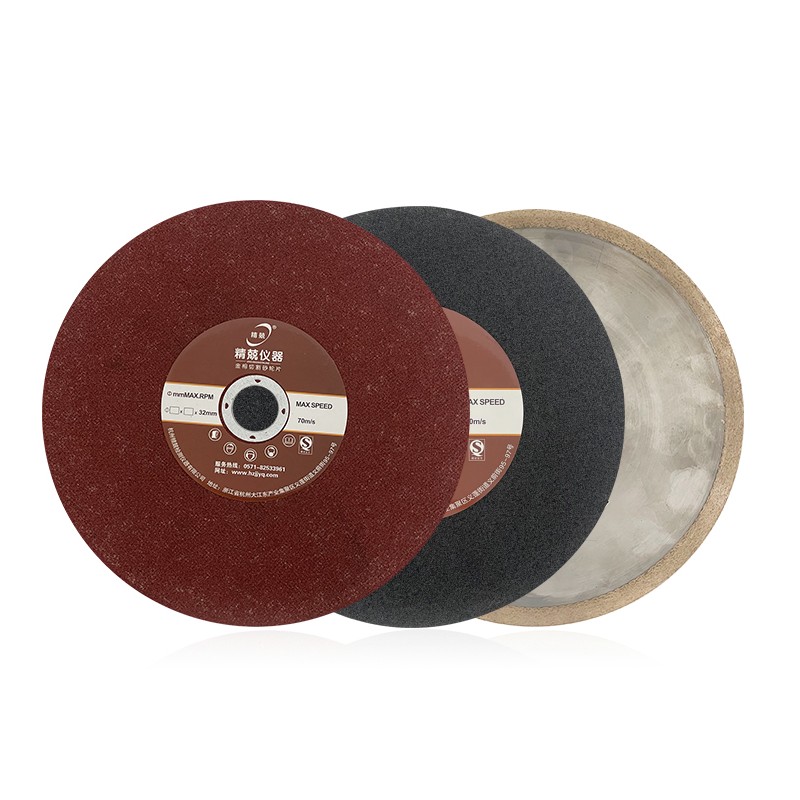 Resin-Bond Metallographic Cutting Disc for Hardness-Matched Sample PrepChoose a disc grit that suits your sample hardness, from coarse 24 to fine 120. It delivers smooth, low-deformation cuts ideal for metallographic preparation of metals and ceramics.View Product →
Grit Size, Structure, and Wheel Dimensions
Grit size
The grit number on the wheel marking, such as 24, 36, 46, 60, 80, or 120, refers to the average abrasive particle size. Coarse grits cut aggressively, produce less heat, and suit soft materials and large cross-sections. Fine grits give a smoother edge, a narrower kerf, and a more controlled action, which is why they are used for thin-walled sections, hardened steel, and cuts where the edge finish matters.
Structure and porosity
Structure describes the spacing between grains. An open structure leaves room for chips and lets air or coolant reach the cutting zone, keeping the wheel cool; use it for soft, gummy metals and heat-sensitive alloys. A dense structure holds more grains per volume, gives longer wheel life and a cleaner edge, but demands more power and is more likely to overheat on hard materials.
Wheel thickness and diameter
Thin wheels, roughly 1 mm to 1.6 mm, remove less material, generate less heat, and give the cleanest cut; they are preferred for stainless tube, sheet, and laboratory sectioning. Thick wheels, roughly 3 mm to 6 mm, are stiffer and cut straighter on solid bars and heavy sections. The wheel diameter must suit the spindle speed: the maximum operating speed of the wheel must never be lower than the machine no-load speed.
Match the Wheel to the Machine and Cutting Conditions
The same material hardness behaves differently on different machines. A chop-stroke saw applies fixed downward pressure; an oscillating saw uses a pendulum movement that clears chips effectively; a swing-frame machine is portable and made for large workpieces. In a metallographic laboratory, a wet abrasive cutter gives the most controlled cutting conditions for hard materials.
Whatever the machine type, never force the wheel through the cut. Use a consistent feed and let the wheel cut at its natural rate. A correct wheel will self-sharpen during the cut; an incorrect one will slow down, spark excessively, or vibrate.
Wet cutting is a major advantage on high-hardness alloys. Coolant prevents overheating of the workpiece and the wheel, reduces glazing, flushes out chips, and extends wheel life. When wet cutting is not available, reduce the feed rate and move to a softer bond. Operators who need exact speed and coolant settings can follow our cut-off machine wheel selection guide covering speed, feed, and coolant.
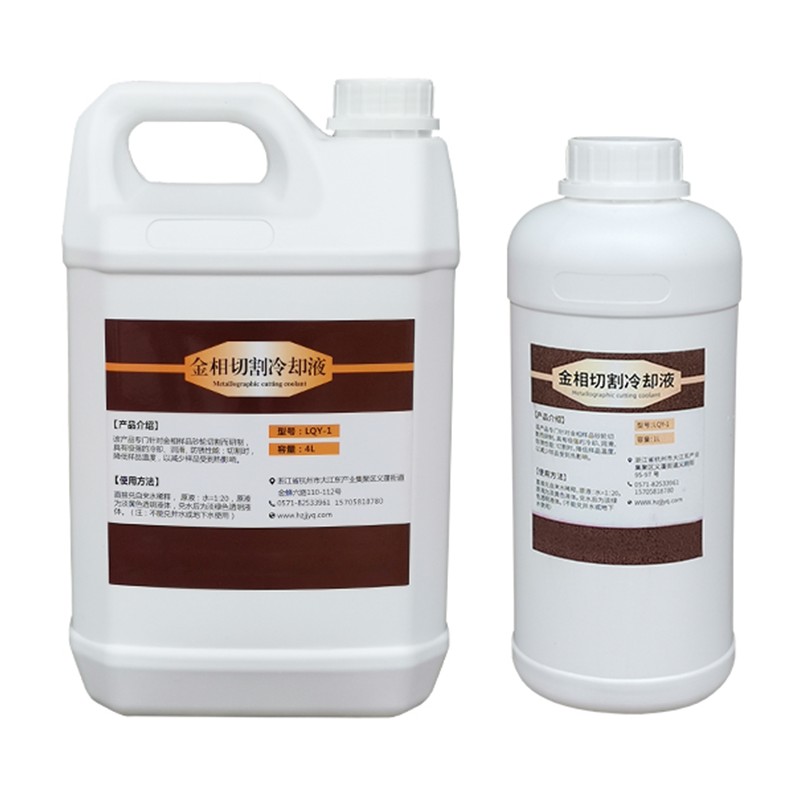 Dilutable Cutting Coolant for Metallographic Wet CuttingThis coolant reduces friction and heat during wet cutting, protecting both sample and wheel. Mix 1:20 with water for a clear solution that prevents oxidation and eases observation.View Product →
For laboratories that section samples before hardness testing or microscopic observation, the cutting process must produce a flat, undeformed surface. A forced-feed wet cutter such as the QG series sample cutting machine is a common setup, and in this configuration the cutting disc, coolant, and feed settings are all chosen from the sample hardness.
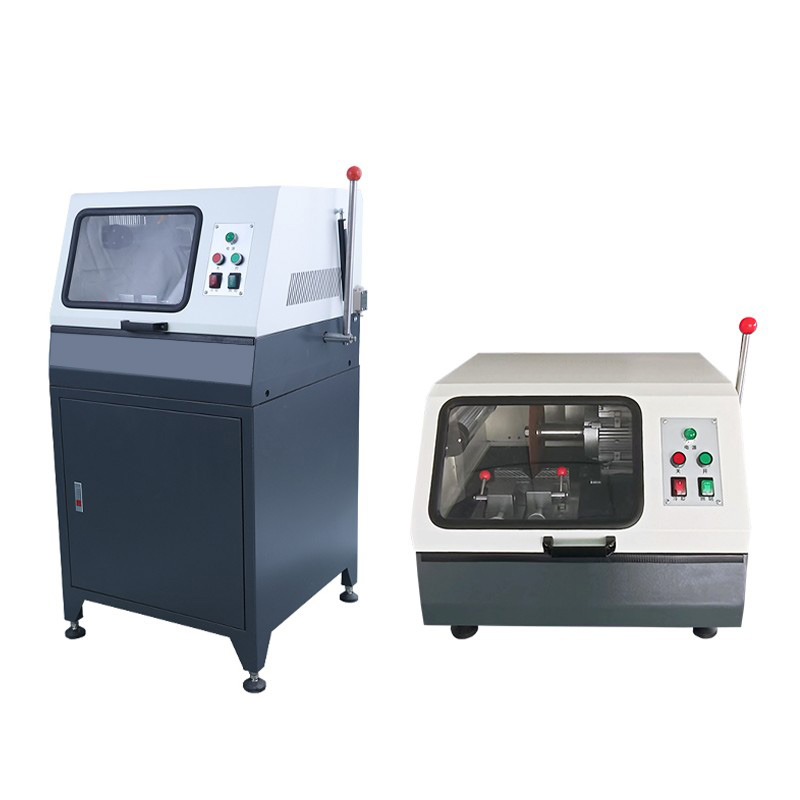 QG Series Metallographic Sample Cutting Machine with Cooling SystemA forced-feed wet cutter available in benchtop or stand models, offering single or double handles. It provides clean, burr-free cuts with minimal deformation for ferrous and non-ferrous samples.View Product →
Safety and Operating Guidelines
Abrasive cut-off wheels rotate at high speed, and a broken wheel can cause serious injury. Apply these rules to every wheel you select:
- Check the maximum operating speed printed on the wheel and never exceed it.
- Inspect each wheel before mounting and reject wheels with cracks, chips, or a damaged arbor hole.
- Use the correct flange diameter so the wheel is clamped evenly on both sides.
- Always use the machine guard and wear eye protection, a face shield, and hearing protection.
- Never apply lateral force or grind with the side of a straight cut-off wheel.
- Stop the machine if the wheel vibrates, runs out of true, or makes an erratic cut.
Material hardness decides which wheel goes on the spindle; it never changes these safety rules.
Frequently Asked Questions
Q1: Why does a hard material need a soft-bonded cut-off wheel?
A soft bond releases dull abrasive grains before they create excessive friction and heat. On hardened steel or nickel alloys, grains dull quickly, so the bond must wear just fast enough to expose fresh sharp grains. A hard bond would keep the dull grains in place and cause burning and glazing.
Q2: Can one cut-off wheel cut all metals?
No. A wheel optimized for soft steel will glaze or burn on hardened material, while a soft-bonded wheel on aluminum will wear quickly and leave a rough edge. The grain, bond, and grit must match the material hardness for both cut quality and safe operation.
Q3: What should I do if the wheel glazes on stainless steel?
Glazing normally means the bond is too hard for the material at the current speed and feed. Move to a softer bond grade, increase the feed slightly, use wet cutting if available, or switch to zirconia or ceramic alumina grain to keep the cutting edges active.
Q4: Which is better, a thin or a thick cut-off wheel?
It depends on the job. A thin wheel produces less heat and waste and gives a better finish on thin or precision work. A thick wheel is stronger, cuts straighter on heavy sections, and lasts longer, but removes more material and generates more heat.
Q5: How do I verify that a wheel matches my machine speed?
Read the maximum operating speed, given in RPM or meters per second, on the wheel label and compare it with the spindle speed of the machine. The machine speed must not exceed the wheel rating, and using a smaller wheel on a high-speed machine can push the surface speed beyond the safe limit.

