

 English
  Español
  Deutsch

Choosing the right metallographic cutting machine is one of the most consequential decisions in sample preparation. The choice between a manual and an automatic cutter affects your budget, the speed of your workflow, the repeatability of your results, and the quality of the surfaces that finally reach the microscope. This guide compares manual and automatic metallographic cutting machines across three key dimensions: cost, efficiency, and sample consistency, so you can make a practical decision for your laboratory.
Content
- 1 What Is a Metallographic Cutting Machine?
- 2 Manual vs. Automatic: How They Work
- 3 Cost Comparison: Upfront and Long Term
- 4 Efficiency and Throughput
- 5 Sample Consistency and Metallurgical Integrity
- 6 Operator Skill, Safety, and Flexibility
- 7 How to Choose the Right Cutting Machine
- 8 Frequently Asked Questions
What Is a Metallographic Cutting Machine?
Metallographic cutting is the first step in preparing a specimen for microscopic examination. A cutting machine uses an abrasive wheel to remove a controlled slice from a bulk material, producing a flat, representative sample while minimizing deformation, burning, and cracking. The quality of this step directly affects all subsequent grinding, polishing, and etching stages. Cutting machines range from compact bench-top units to heavy-duty floor models, and their controls span fully manual feed systems, semi-automatic drives, and fully programmable automatic cycles. Typical workpieces include steels, cast irons, aluminum alloys, copper alloys, titanium, cemented carbides, ceramics, and electronic boards.
Manual vs. Automatic: How They Work
In a manual cutting machine, the operator advances the cutting wheel or the sample by turning a handle, controlling the feed rate, cutting pressure, and travel path by hand. In an automatic machine, a motor-driven feed system and a programmable controller govern the same parameters. Semi-automatic models sit between the two: the operator positions and clamps the specimen, and the machine feeds the wheel at a constant rate.
- Manual operation: operator-controlled feed, lower initial cost, maximum flexibility for mixed samples.
- Automatic operation: programmable feed rate and depth, high repeatability, reduced operator fatigue.
- Semi-automatic operation: automated feed with manual specimen setup, a practical middle ground for busy labs.
| Aspect | Manual | Automatic |
|---|---|---|
| Initial cost | Lower | Higher |
| Feed rate control | Operator dependent | Programmable and stable |
| Sample-to-sample repeatability | Variable | Excellent |
| Required operator skill | High | Low |
| Throughput for batches | Moderate | High |
| Maintenance complexity | Simple | More involved |
| Risk of cutting damage | Higher with unskilled use | Lower |
Cost Comparison: Upfront and Long Term
Manual cutting machines win on purchase price. Their simpler mechanics mean a lower sticker price, which is why small workshops, teaching laboratories, and occasional testing facilities often choose them. Automatic machines carry a higher initial investment because they add feed motors, controllers, clamping fixtures, and safety interlocks. Entry-level automatic units have narrowed the gap, but the price difference remains meaningful.
Long-term economics often favor automatic machines in high-throughput laboratories. An automatic cutter can run multiple identical samples with little supervision, freeing laboratory staff for grinding, polishing, and analysis tasks. It also reduces the number of rejected samples caused by inconsistent feed pressure, lowering re-preparation costs and consumable waste. For low volumes or highly varied materials, however, a well-maintained manual cutter remains the most economical option.
Efficiency and Throughput
Efficiency is not measured only by cutting speed; it is measured by the number of acceptable samples produced per shift. An automatic cutting machine maintains a consistent feed rate from the first sample to the last, and it can return the wheel to the starting position automatically, which makes batch processing uninterrupted. A manual machine can be equally quick in the hands of a practiced operator, but it demands continuous attention and physical effort. In long production runs or with repeated identical specimens, automatic cutters deliver clearly higher productivity.
For laboratories that need to section medium and large steel blanks without slowing down the metallographic workflow, a robust general-purpose cutting machine with a powerful spindle and rigid clamping system makes a measurable difference.
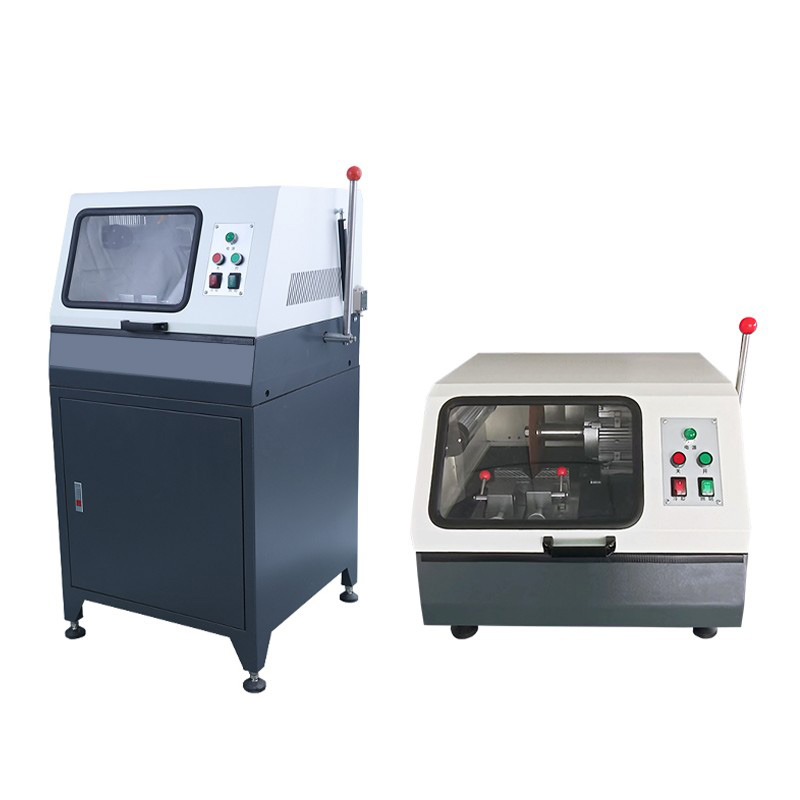 QG Series Metallographic Sample Cutting Machine for General-Purpose SectioningDesigned for sectioning medium to large steel blanks, the QG series offers multiple cutting capacities and benchtop or stand configurations. Its cooling system and reinforced grinding wheel help ensure clean, low-deformation cuts, supporting reproducible metallographic results in accredited labs.View Product →
Sample Consistency and Metallurgical Integrity
Sample consistency is the area where automatic machines show the clearest advantage. Metallographic conclusions are only comparable when every specimen is cut under identical conditions. An automatic cutter controls feed rate, applied force, and cutting travel with repeatable precision. Manual cutting depends on the operator's steady hand; subtle changes in pressure or angle can cause grinding burn, plastic deformation, or micro-cracks. These artifacts may lead to incorrect microstructural readings, especially in heat-treated steels, coatings, and composite materials. For failure analysis and quality certification, reproducibility is not optional. This is why accredited laboratories usually prefer automatic or semi-automatic cutting.
For small, delicate specimens where gentle feed is critical, a manual precision cutter with a low-speed wheel still earns its place on the lab bench.
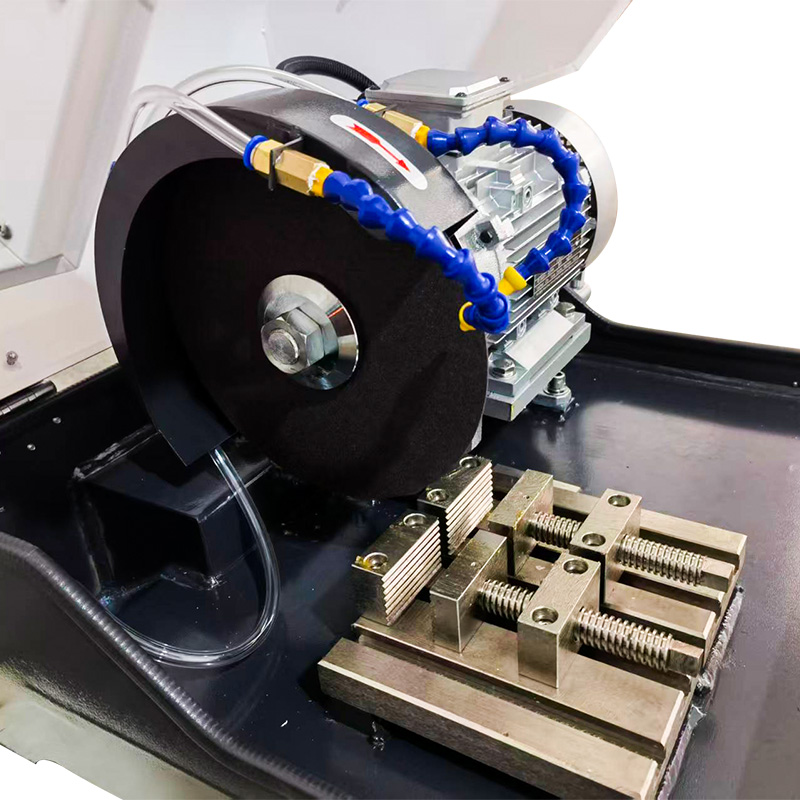 Q/SQ Series Manual Precision Cutting Machine for Delicate SpecimensThis manual precision cutter provides gentle, low-speed cutting for small or fragile samples. With rugged construction and optional adjustable speed and cooling in the SQ series, it preserves sample integrity while giving operators direct control for prototype and unusual work.View Product →
Operator Skill, Safety, and Flexibility
Manual cutting demands more operator skill and keeps the operator close to a rotating abrasive wheel. Automatic machines isolate the operator from the cutting zone with protective covers, interlocks, and remote controls, reducing injury risk and physical fatigue. At the same time, manual machines offer a degree of flexibility that automation cannot easily match. An experienced operator can react instantly to sparks, sound, and vibration, adjusting the feed to protect a difficult material. Automatic machines perform best when the material is known and the cutting parameters have already been optimized. Many laboratories keep both types: an automatic machine for routine batches and a manual machine for prototype work and unusual samples.
How to Choose the Right Cutting Machine
Begin by defining your samples, your daily volume, and your quality requirements. If you prepare a small number of varied materials and need the lowest initial investment, a manual cutting machine is a practical answer. If you process batches of similar samples and need repeatable, documentable working conditions, an automatic or semi-automatic machine is worth the investment. Remember that consumables are just as important as the machine. A correct cutting wheel and an effective coolant prevent heat damage and extend wheel life; see our guide to cutting wheel selection, speed, and coolant for practical recommendations.
Flat sheet-metal parts, electronic boards, and other plate-like samples cut more cleanly on a dedicated precision plate cutting machine, while routine round and block samples are handled efficiently by a general-purpose metallographic cutting machine.
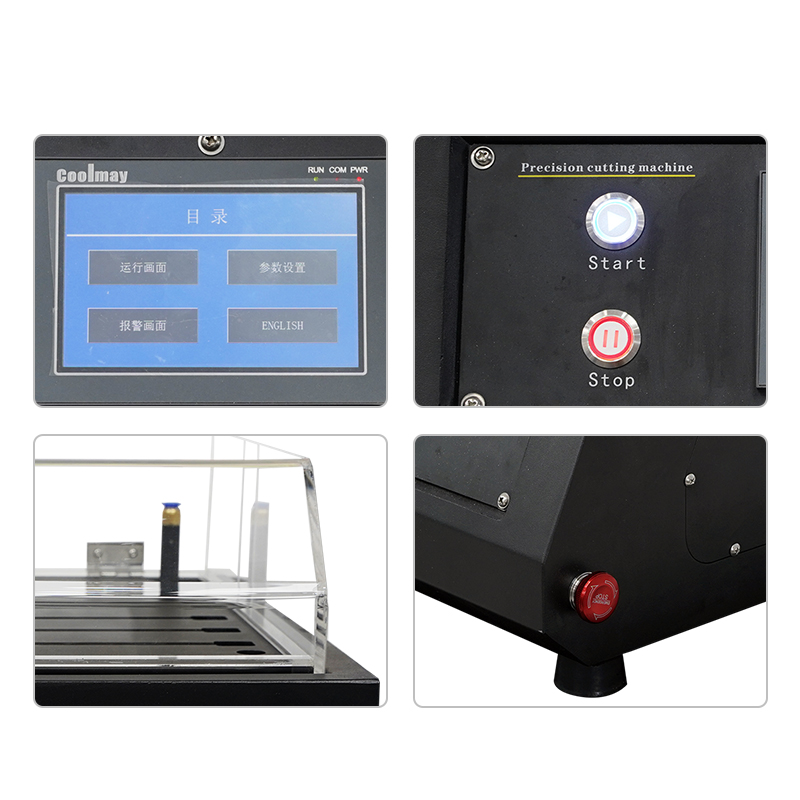 PBQ-200 Precision Plate Cutting Machine for Flat SamplesThe PBQ-200 features a 200 mm diamond wheel, adjustable speed, automatic feed, and a touchscreen interface. Specifically designed for flatbed cutting, it handles semiconductors, circuit boards, rocks, and ceramics with clean, minimal thermal effects, suiting research and quality labs.View Product →
Frequently Asked Questions
Q1: Is an automatic metallographic cutting machine worth the extra cost?
For high-volume laboratories, yes. Automatic cutting reduces labor requirements and rejected samples, which quickly offsets the higher purchase price. For occasional or highly variable work, a manual machine is usually more cost-effective.
Q2: Can manual cutting produce the same sample quality as automatic cutting?
In experienced hands, a manual machine can produce excellent surfaces. However, quality varies from operator to operator and even from sample to sample. Automatic cutting removes human variability, so every specimen is cut under the same conditions, which is essential for comparative and certification work.
Q3: What consumables are needed for metallographic cutting?
You need abrasive cutting wheels matched to the material, a cutting coolant that suppresses heat, and solid clamping fixtures. Consumables influence cutting quality as much as the machine itself, so always pair them with the recommended specifications.

