

 English
  Español
  Deutsch
Content
- 1 The Foundation of Accurate Metallographic Analysis: Sample Preparation
- 2 Metallographic Pre-Processing Equipment: Core Instruments
- 3 Metallographic Mosaic Powder: Mounting Compound Selection and Performance
- 4 Metallographic Polishing Cloth: Nap, Hardness, and Application Matching
- 5 Polishing Abrasive Liquids: Diamond, Alumina, and Silicon Dioxide Compared
- 6 Building a Preparation Sequence: Matching Equipment and Consumables to Material
The Foundation of Accurate Metallographic Analysis: Sample Preparation
Metallographic pre-processing equipment and consumables form the critical first stage of materials characterization workflows. Before a sample reaches the microscope—whether optical, scanning electron, or electron backscatter diffraction—its surface must be prepared to a standard that reveals true microstructural features without introducing artifacts from sectioning, mounting, or abrasion. A poorly prepared sample cannot be corrected at the imaging stage; deformation layers, relief, smearing, and pull-out voids created during preparation are permanent and will produce misleading analytical results.
The pre-processing sequence follows a defined progression: sectioning → mounting → planar grinding → coarse polishing → fine polishing → final polishing → etching. Each stage depends on the correct combination of equipment capability and consumable selection. The range of consumables—metallographic mosaic powder, polishing cloths, alumina liquid, diamond suspension, and silicon dioxide colloidal solutions—each serve a specific function within this sequence and are not interchangeable.
Metallographic Pre-Processing Equipment: Core Instruments
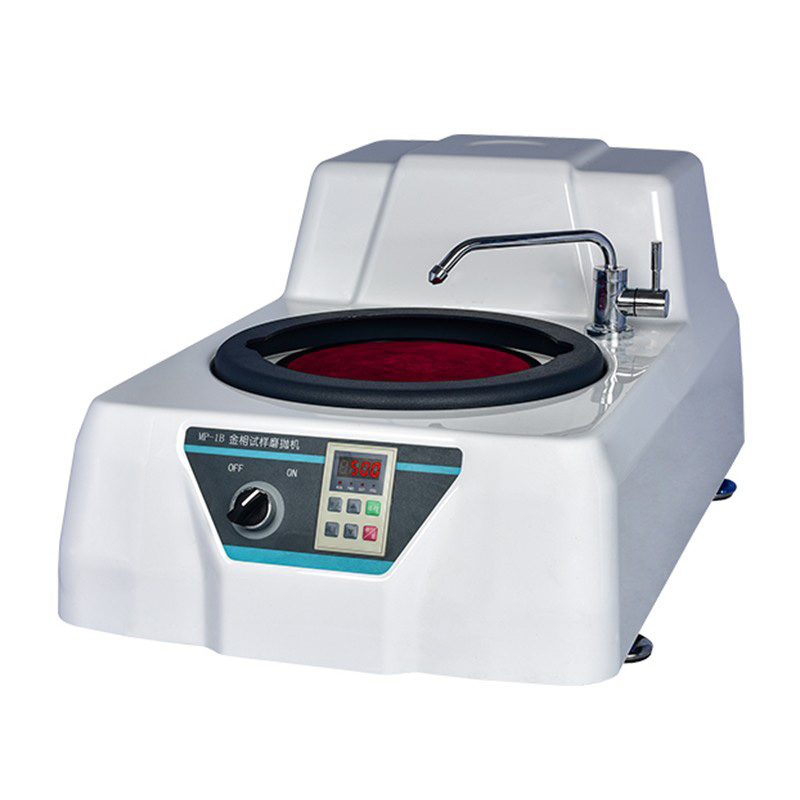
A complete metallographic preparation laboratory requires a suite of instruments, each engineered for a specific stage of sample processing. Equipment selection must account for sample material hardness, throughput requirements, and the surface finish specification demanded by downstream analytical techniques.
Sectioning and Cutting Equipment
Abrasive cut-off machines and precision diamond wire saws are the two primary sectioning technologies used in metallographic laboratories. Abrasive cut-off machines use resin-bonded or rubber-bonded cutting wheels rotating at 2,800–3,500 RPM with continuous coolant flood to minimize thermal damage zones. For ferrous alloys, aluminum oxide wheels are standard; for non-ferrous and ceramic materials, silicon carbide wheels are preferred. Precision cut-off machines fitted with specimen vices and feed-rate control achieve sectioning-induced deformation layers of less than 50 µm in hardened steels, compared to 200–500 µm for hand-operated angle grinders. Diamond wire saws operate at significantly lower cutting forces and are the correct choice for brittle ceramics, semiconductor materials, and archaeological specimens where minimizing mechanical damage is paramount.
Mounting Presses
Hot compression mounting presses encapsulate sectioned specimens in thermosetting or thermoplastic resin under controlled temperature and pressure. Standard operating parameters for phenolic and epoxy mounting compounds are 150–180°C at 250–300 bar, held for 4–8 minutes followed by a water-cooled pressure release cycle. Modern automatic mounting presses execute the full cycle without operator intervention and provide consistent mount geometry—critical for automated polishing systems that use specimen holders with fixed height tolerances. Mounting press cylinder diameter (25 mm, 30 mm, 40 mm, and 50 mm are standard) determines the mount size and must match the specimen holder diameter of the polishing system in the laboratory.
Grinding and Polishing Systems
Automated grinding and polishing machines are the highest-impact equipment investment in a metallographic laboratory. Semi-automatic and fully automatic systems use a rotating platen with a counter-rotating specimen head, applying programmable downforce (typically 10–50 N per specimen), rotation speed (50–300 RPM), and processing time for each consumable step. The reproducibility of automated systems eliminates operator-to-operator variability in surface finish and edge retention—the two most common sources of preparation-induced error in manual polishing workflows. Central force systems apply force to the entire specimen holder assembly; individual force systems apply controlled force to each specimen independently, which is required when processing specimens of dissimilar hardness in the same holder.
Metallographic Mosaic Powder: Mounting Compound Selection and Performance
Metallographic mosaic powder—also referred to as mounting resin or embedding compound—serves multiple functions beyond simply holding the specimen in a convenient geometry. The mounting material must support the specimen edge during grinding and polishing to prevent rounding, resist the solvents and etchants used in subsequent preparation steps, and provide sufficient hardness contrast with the specimen to avoid differential relief polishing.
The principal mounting compound types and their selection criteria are:
- Phenolic (Bakelite) powder — The standard choice for ferrous alloys and most industrial metals where edge retention is not critical. Cures to a hard, opaque mount with a Vickers hardness of approximately 35–45 HV. Resistant to most etchants including nital and Keller's reagent. Processing temperature: 150–160°C.
- Diallyl phthalate (DAP) powder — Preferred when superior edge retention is required, such as for coatings, case-hardened layers, and surface treatments. DAP mounts are harder than phenolic (50–60 HV) and exhibit lower shrinkage during cure, producing better specimen-to-mount interface contact and reducing the risk of gap formation that leads to edge rounding.
- Mineral-filled epoxy powder — Used for specimens requiring maximum edge retention and chemical resistance. Filler particles (typically aluminum oxide or silicon carbide) increase mount hardness to 60–80 HV and improve polishability to a level closer to that of many metal specimens, reducing differential relief.
- Conductive mounting powder — Graphite-filled or copper-filled phenolic compounds that produce electrically conductive mounts for SEM and EBSD analysis without the need for sputter coating. Conductivity values of 10⁻² to 10⁻¹ S/cm are achievable with copper-filled formulations.
For heat-sensitive specimens—solders, polymers, and low-melting-point alloys—cold-cure epoxy or acrylic systems replace hot compression mounting entirely, curing at room temperature under minimal pressure over 8–24 hours.
Metallographic Polishing Cloth: Nap, Hardness, and Application Matching
Polishing cloth selection is one of the most consequential consumable decisions in metallographic preparation because the cloth controls the cutting geometry of the abrasive suspension used at each polishing step. The cloth material, nap height, and hardness determine how abrasive particles are held and how freely they move across the specimen surface—directly affecting material removal rate, scratch depth, and relief formation.
| Cloth Type | Nap Height | Hardness | Best Application |
|---|---|---|---|
| Woven nylon / polyester | None (hard) | Very hard | Planar grinding, hard ceramics, coatings |
| Short nap synthetic (MD-Largo type) | Low (0.5–1 mm) | Hard | Coarse diamond polishing, hard alloys |
| Medium nap wool / felt blend | Medium (1–2 mm) | Medium | Intermediate diamond polishing, steels |
| Long nap velvet / silk | High (2–4 mm) | Soft | Final oxide polishing (OPS/alumina) |
| Chemomechanical cloth (porous polymer) | Micro-porous | Semi-hard | Colloidal silica final polish, EBSD prep |
A common preparation error is using a cloth with excessive nap height at the diamond polishing stage. High-nap cloths allow abrasive particles to move freely and adopt random orientations, producing multidirectional scratching and increased relief between phases of different hardness. Hard, low-nap cloths used with diamond suspensions produce more directional, shallower scratches that are removed efficiently at the subsequent polishing step.
Polishing Abrasive Liquids: Diamond, Alumina, and Silicon Dioxide Compared
The three principal polishing abrasive liquid families used in metallographic preparation—diamond suspension, alumina polishing liquid, and colloidal silicon dioxide—occupy distinct positions in the preparation sequence and are selected based on the material being prepared, the surface finish required, and the analytical technique that follows.
Diamond Polishing Liquid
Diamond polishing suspensions are the primary abrasive for the coarse and intermediate polishing stages. Synthetic monocrystalline or polycrystalline diamond particles are suspended in either a water-based or oil-based carrier at concentrations of 0.1–2.0 carats per 100 mL. Particle size grades range from 9 µm (coarse) through 6 µm, 3 µm, 1 µm, and 0.25 µm (fine), with each step removing the scratch layer introduced by the previous grade. Diamond's hardness of 10 on the Mohs scale makes it effective on all metallic and ceramic materials, including hardened steels above 65 HRC, tungsten carbide, and alumina ceramics that cannot be polished with softer abrasives. Water-based diamond suspensions are compatible with most polishing cloths and are the standard choice for automated systems; oil-based suspensions reduce aqueous corrosion on reactive metals such as aluminum alloys and magnesium.
Alumina Polishing Liquid
Alumina (Al₂O₃) polishing suspensions are used primarily for intermediate to final polishing of non-ferrous metals, copper alloys, aluminum, and titanium. Available in alpha-alumina (monocrystalline, harder, more aggressive) and gamma-alumina (polycrystalline, softer, produces finer finish) forms, at particle sizes of 0.05 µm, 0.3 µm, and 1.0 µm. Alumina suspensions are typically applied on medium-nap wool or synthetic cloths and achieve surface roughness values of Ra < 5 nm on aluminum alloys. A key limitation of alumina is its tendency to embed in soft metals—particularly pure aluminum and copper—leaving white residue visible under the microscope that can be misidentified as second-phase particles. Thorough ultrasonic cleaning in isopropanol after alumina polishing is essential before proceeding to etching or SEM examination.
Silicon Dioxide (Colloidal Silica) Polishing Liquid
Colloidal silicon dioxide suspensions—commonly referred to as OPS (oxide polishing suspension)—are the standard final polishing abrasive for EBSD sample preparation and for materials where the highest surface quality is required. Colloidal silica particles of 0.02–0.06 µm in a mildly alkaline carrier (pH 9.5–10.5) perform both mechanical abrasion and chemical dissolution of the deformed surface layer simultaneously. This chemomechanical action removes the thin amorphous deformation layer that remains after diamond polishing—a layer that is invisible in optical microscopy but produces poor Kikuchi pattern quality in EBSD. Colloidal silica is particularly effective on titanium alloys, nickel superalloys, stainless steels, and refractory metals. Processing times of 15–45 minutes on a vibratory polisher or 2–5 minutes on a rotary polisher with a chemomechanical cloth are typical. The alkaline pH requires careful handling and thorough rinsing to prevent surface staining, and colloidal silica suspensions must be prevented from drying on the cloth or specimen surface as the dried gel is difficult to remove without reintroducing surface damage.
Building a Preparation Sequence: Matching Equipment and Consumables to Material
Effective metallographic preparation requires selecting equipment and consumables as an integrated sequence rather than in isolation. The following principles guide sequence design across material categories:
- Hard ferrous alloys (steels >400 HV) — Hot compression mount with DAP or mineral-filled powder → SiC grinding papers 220/500/1200 grit → 9 µm diamond on hard cloth → 3 µm diamond on medium cloth → 1 µm diamond on short-nap cloth → colloidal silica on chemomechanical cloth for EBSD, or direct etch after 1 µm for optical microscopy.
- Aluminum alloys — Cold cure epoxy mount (to avoid age hardening effects from press heat) → SiC papers → 3 µm diamond on medium cloth → 0.3 µm alumina on soft cloth → 0.05 µm colloidal silica on vibratory polisher for EBSD. Avoid excessive pressure at all polishing stages to prevent smearing of the soft matrix.
- Cemented carbides and ceramics — Phenolic or conductive mount → diamond grinding disc (70–125 µm) → 15 µm diamond on hard cloth → 6 µm diamond → 3 µm diamond → 1 µm diamond on short-nap cloth. Alumina and colloidal silica are generally ineffective on materials harder than 1,500 HV.
- Thermal spray coatings and multilayer systems — Vacuum epoxy impregnation before mounting to fill coating porosity and prevent pull-out → DAP or mineral-filled mount → low-pressure grinding to minimize coating delamination → fine diamond sequence with reduced force. Edge retention is the primary quality criterion; relief formation between substrate and coating exceeding 0.5 µm makes coating thickness measurement unreliable.
Documenting the complete preparation sequence—including equipment model, consumable brand and grade, applied force, platen speed, and processing time—for each material type allows laboratories to reproduce results consistently across operators and over time, which is a core requirement for ISO/IEC 17025 accredited materials testing facilities.

